Houda Bakkali presented her artwork at Barcelona’s Can Travi Civic Center as part of the Empoderat Festival. The exhibition stood out for two works that seamlessly fused artistic creativity with new technologies, using them as a powerful medium to communicate medical and scientific knowledge.
Tag: Houda Bakkali
Houda Bakkali at the Mois de la Francophonie 2026: Art, Technology, and Public Engagement
Houda Bakkali will participate in the Month of Francophonie 2026, an international event celebrating Francophone cultures. Her work will be exhibited at various venues of the Alliance Française across different countries.
Bakkali’s artistic practice integrates physical art, augmented reality, animation, and interactivity. This combination invites audiences to experience and engage with each piece in a dynamic and sensory manner, expanding the boundaries of the canvas, redefining the exhibition space itself, and establishing a new form of communication with the public. The exhibitions will also be complemented by educational materials and workshops led by Bakkali on the impact of emerging technologies in the arts. These sessions aim to contextualize the applications and uses of new technologies within traditional artistic and cultural environments, while fostering dialogue on the relationship between art and technology as a means to inform, educate, and entertain.
As in previous exhibitions, these showcases will be experienced simultaneously in different countries, creating a creative axis that seeks to transcend temporal, generational, and spatial boundaries. Through art and technology, Bakkali’s initiative aspires to foster a universal, cross-disciplinary, and diverse dialogue, positioning art and culture as accessible, comprehensible, and inclusive goods.
“It is an honor to participate in an event that celebrates diversity, creativity, and friendship. It offers me the opportunity to share my work and creative vision with different communities around the world, to engage with their sensibilities, and to contribute to the ongoing debate surrounding the challenges and opportunities that technology presents for the ecosystem of art and culture. It is an honour to be able to exhibit and bring my work to life through the Alliance Française, the largest and oldest cultural and educational network in the world. My sincere thanks to its outstanding professionals for their motivation, respect and commitment, a true reflection of France’s excellence.” Bakkali states.
These exhibitions, organized within the framework of Francophonie Month 2026, complement other Bakkali’s shows currently on display in various countries across the network of French Alliances.
Abu Dhabi, Emirates; Auckland, New Zealand; Bogotá, Colombia; Cali, Colombia; Cartagena de Indias, Colombia; Ciudad de Guatemala, Guatemala; Ciudad de México, Mèxico; Cuenca, Ecuador; Cuernavaca, Mèxico; Delhi, India; Guayaquil, Ecuador; Hyderabad, India; Jeddah, Saudi Arabia; Kampala, Uganda; Kandy, Sri Lanka; Kuala Lumpur, Malaysia; La Antigua, Guatemala; La Plata, Argentina; Loja, Ecuador; Lusaka, Zambia; Madrid, Spain; Makassar, Indonesia; Manama, Bahrain; Maracay, Venezuela; Matara, Sri Lanka; Mèrida, Mèxico; Penang, Malaysia; Phuket, Thailand; Piura, Perú; Portoviejo, Ecuador; Querètaro, Mèxico; Quito, Ecuador; San Diego, United States; Santa Cruz de la Sierra, Bolivia; Trujillo, Perú; Valdivia, Chile; Villahermosa, México.
Art, Science, Technology: Seven Concepts Without Limits
Art meets science, inviting us to immerse ourselves in it and to discover it through the potential of new technologies. Learning is transformed into an experience capable of constantly reinventing itself, able to measure results, update content, and share knowledge in real time and without limits.
Creativity and new technologies foster the universalization and democratization of knowledge through accessible tools that are easy to understand and share. They encourage two-way communication, intercultural dialogue, and social debate about the real impact of the synergy between creativity and new technologies in the dissemination of science.
In this sense, each concept fulfills a necessary function that feeds back into the others.
Science lays the foundation. It is the concept, the method, the process. It shapes the message, explains, and answers every question through the most authoritative sources. It invites us to reason. It advances without limits.
Art is the vehicle that carries science to all audiences, on a global scale, without borders. It humanizes the rigor of science, puts unlimited creativity and the artist’s signature at the service of deep knowledge.
Technology creates the experience. Opens the communication process to different platforms, to different media and formats. It makes the process have no spatial, temporal or generational barriers. Use the resources that exist and invite us to be attentive to what is to come. To know and to build, without limits. Technology prioritizes information, allows us to decide times, forms, spaces and gives us power over the choice of each element. It helps us create understandable, comprehensive and manageable content.
Immersion favors the experience, enriches it, broadening it. It encourages curiosity and participation. Art ceases to be on the wall and moves to any space. The play is enjoyed in different ways and at any time. It is allowed to be explored, felt, debated, shared. It grows, challenging the limitations.
Fun through science outreach aims to foster active participation. It connects in-depth scientific theory, creative work, and the sensory experiences that technology provides for communication, information, and training through more playful spaces. It represents limitless recreation.
The version, in this context, is synonymous with versatility. We create in every moment and according to every moment. We adapt creativity to the message, the message to space, space to the public. And vice versa. The combination can be unlimited.
The limit can be infinite and can be marked by the unpredictable rhythm of the imagination. It can also be hierarchical and can be marked by the precise rhythm of science. Technology gives us the tools and the tools give us the advantage of being able to work in both scenarios, merge them, exchange them or reinvent them. The challenge is knowing how to assess not only the creative framework, but also the challenges, opportunities, and risks that this fusion of creativity and new technologies invites us to explore also in an unlimited way.
Augmented Reality
Houda Bakkali | Physical Piece + AR Version
Digital Creativity and Cultural Dialogue Across the Alliance Française Network
Houda Bakkali has developed since 2024 an international artistic and educational programme within the Alliance Française, centred on the dissemination of digital and immersive artistic practices as tools for expanding access to knowledge, creativity, and intercultural exchange. Implemented across 36 cities in 22 countries, this project brings together artistic production, learning environments, and public cultural spaces through exhibition formats that combine physical displays, digital content, and immersive technological experiences.
Most of Bakkali’s exhibitions have been accompanied by talks and masterclasses examining the challenges and opportunities that emerging technologies present for artists and cultural organisations. These activities explore how technology-driven artistic practices extend beyond traditional canvases and physical exhibition settings, generating impact in fields such as healthcare, scientific research, education, and cultural development.
Within this institutional context, Bakkali has designed and implemented hybrid exhibition models that interconnect on-site and virtual environments, enabling the simultaneous presentation of artistic productions across multiple geographical and cultural contexts. These approaches prioritise accessibility, interdisciplinary learning, and the development of virtual and technological literacy, positioning technologically mediated art as a pedagogical, research-oriented, and knowledge-transfer medium.
Since 2024, Bakkali has participated in international cultural programmes organised by the Alliance Française and the Institut Français, including the Month of Francophonie and Novembre Numérique. During the 2025 edition of Novembre Numérique, coordinated by the Institut Français in Paris to promote global access to emerging technologies and encourages dialogue between creators and audiences through exhibitions hosted in embassies, cultural centres, universities, galleries, and public spaces worldwide, Bakkali’s creations were presented simultaneously in 11 cities across 9 countries through interconnected exhibitions demonstrating the capacity of digital artistic expression to generate shared cultural experiences while preserving strong local contextualisation.
Through the Alliance Française, Bakkali’s artistic practice has been presented in a wide range of academic, cultural, and community-oriented environments. These include solo exhibitions at Alliance Française of Abu Dhabi, Al Riwaq Art Space in Bahrain and the Hayy Jameel Residents – Alliance Française of Jeddah, where her exhibitions were focused on public engagement with contemporary digital visual culture.
Her projects have also been exhibited in academic and educational institutions, including Colegio Laico de Valdivia (Chile), Discovery School de Cuernavaca (Mexico), Terrapuerto de Trujillo (Peru), University of Piura, and Universidad Privada Antenor Orrego (UPAO). In addition, her art and creative vision were presented within the Sofar Kampala cultural festival in Uganda, further expanding the geographical scope of her artistic dissemination activities. Likewise, Alliance Française network in Ecuador presented the exhibition Digital Art, Digital Culture by Houda Bakkali, developed in physical and virtual formats across five venues (Guayaquil, Loja, Quito, Cuenca and Portoviejo), along with a free workshop exploring the challenges, opportunities, and wider applications of digital art and augmented reality.
Abu Dhabi, Emirates; Auckland, New Zealand; Bogotá, Colombia; Cali, Colombia; Cartagena de Indias, Colombia; Ciudad de Guatemala, Guatemala; Ciudad de México, Mèxico; Cuenca, Ecuador; Cuernavaca, Mèxico; Delhi, India; Guayaquil, Ecuador; Hyderabad, India; Jeddah, Saudi Arabia; Kampala, Uganda; Kandy, Sri Lanka; Kuala Lumpur, Malaysia; La Antigua, Guatemala; La Plata, Argentina; Loja, Ecuador; Lusaka, Zambia; Madrid, Spain; Makassar, Indonesia; Manama, Bahrain; Maracay, Venezuela; Matara, Sri Lanka; Mèrida, Mèxico; Penang, Malaysia; Phuket, Thailand; Piura, Perú; Portoviejo, Ecuador; Querètaro, Mèxico; Quito, Ecuador; San Diego, United States; Santa Cruz de la Sierra, Bolivia; Trujillo, Perú; Valdivia, Chile; Villahermosa, México.
Extended Reality as a Framework for Artistic Innovation and Cultural Dialogue
Bakkali’s artistic output encompasses physical artworks, augmented reality experiences, immersive and interactive pieces, digital animation, audiovisual productions, virtual exhibition environments, and video projections. This multidisciplinary approach encourages the integration of artistic creativity and technological innovation as a means of facilitating knowledge exchange across different cultural spaces.
The exhibition framework “Digital Art, Digital Culture” by Houda Bakkali, reflects the academic and cultural objectives underpinning her practice, demonstrating how digitally mediated artistic production can operate as a universal platform connecting diverse audiences and broadening access to artistic and educational resources. Within the Alliance Française network and its institutional partnerships, Bakkali’s work is situated within initiatives that support international cultural dialogue and examine the role of technologically driven artistic expression in knowledge production and intercultural exchange.
Alliance Française: Culture Without Borders Since 1883
Founded in Paris in 1883 by prominent intellectual and scientific figures including Paul Cambon, Jules Verne, and Louis Pasteur, the Alliance Française is an international organisation dedicated to the promotion of the French language and Francophone cultures. With more than 800 centres operating in over 130 countries, the organisation constitutes one of the most extensive global cultural and educational structures, facilitating artistic circulation, intercultural dialogue, and knowledge transfer through comprehensive academic and cultural programming.
AMITIÉ
DIVERSITÉ
CRÉATIVITÉ
Art beyond Art: Universalité
“Bringing my work to five continents through the Alliance Française represents one of the most meaningful opportunities to share, learn, and enrich my creative process.
It is a continuous growth experience shaped by the excellence of France, the richness of Francophone cultures, and a cultural, linguistic, and artistic dialogue that extends across the globe.
Through this experience, art and emerging technologies not only transcend generational, temporal, and physical boundaries, but also become a powerful expression of creativity and innovation that unites us in diversity, fostering collective growth and the construction of a shared future through enthusiasm and education.
I extend my sincere gratitude to the Alliance Française, as well as to the professionals and institutions that have supported my work and welcomed it into their spaces and communities with remarkable respect, dedication, and commitment.”— Houda Bakkali
Houda Bakkali’s Exhibition Explores the Intersection of Art, Health, and Science
Art and new technologies come together in Houda Bakkali’s exhibition at the Chicó headquarters of the Alliance Française in Bogotá, Colombia. The exhibition will be open to the public until February 07, 2026.
Art is a powerful vehicle for the transmission of knowledge, the exchange of ideas, and the creation of universal messages that transcend spatial, temporal, and generational boundaries. This capacity becomes particularly relevant in the context of health education and public awareness. An artist’s signature, visual language, and personal brand can serve as an effective framework for conveying expert medical knowledge, validated by leading specialists, and for promoting high-quality information, prevention, early diagnosis, and greater awareness of diseases.
The main work of the exhibition is Art for Health, a piece dedicated to raising awareness of breast cancer. This approach underscores the importance of communicating with rigor, clarity, and impact, fostering prevention and early detection, enhancing understanding of the scientific challenges and advances that are shaping improved approaches to the disease, and encouraging a perspective that is both realistic and hopeful.
This artwork combines a large-format physical piece with audiovisual media, interactive elements, and augmented reality. Through its augmented reality version, the artwork allows the public to access medical and scientific content on breast cancer, focusing on prevention, early diagnosis, the importance of communication and health education, as well as the growing impact that new technologies are having in the field of research and early diagnosis.
“Interactivity and audiovisual media enable a deeper connection between the audience and the artwork. Through immersive experiences, viewers can enter the work’s multiple layers, become an active part of the creative process, and access information in a more engaging and intuitive way. This fosters meaningful participation, transforming the audience from passive observers into active participants. Such engagement significantly enhances dissemination, as effective dissemination is not only about understanding, but also about participation,” comments Bakkali.
Houda Bakkali’s Art for Health has been a central part of various outreach workshops led by Houda Bakkali and has been exhibited in numerous venues, from the Can Travi Civic Center in Barcelona where it was first presented in an exhibition space to the headquarters of the legendary Alliance Française in Auckland (New Zealand), Phuket (Thailand), Cuernavaca (Mexico) at Colegio Laico, and the Alliance Française in Valdivia (Chile); as well as at the Terrapuerto and the Alliance Française in Trujillo (Peru), and at the campuses of Antenor Orrego University and the University of Piura, in addition to Mall Plaza Piura and the Alliance Française of Piura, among other spaces.
“Art encompasses everything. Everything exists within art, and art exists within everything. For this reason, translating medical information into works of art enhanced by the unlimited versatility of new technologiestransforms the canvas into a high-impact, practical tool for awareness and understanding. It elevates aesthetics to a new dimension: one defined by functionality and the dissemination of scientific knowledge, conveyed through a creative, approachable, accessible, and easily understandable language,” says Houda Bakkali.
Layers of Art & Science Unveiling the Invisible
On the occasion of the International Day of Women and Girls in Science, I present my project “The Layers of Art & Science”.
“The Layers of Art & Science” is an immersive exploration of my personal journey in the field of medical communication, as well as the emerging forms of communication I have been discovering and developing. This work reflects the multiple cumulative layers of knowledge and practice I have been understanding and implementing, including topics, advances, methods, results, continuity, and challenges.
It stands as a piece distinct from my previous work, in this project I incorporate innovative techniques and new technologies to expand both expression and impact. Through a central professional perspective shaped by experience and continuous learning, this project brings together diverse timelines and processes that, while different, are essential and complementary.
Ultimately, the work aims to highlight the transformative impact of creativity and emerging technologies on the evolution of medical communication.
The Impact of Extended Reality
The use of extended reality (XR) enables me to introduce interactive dimensions into my work, allowing experimentation with diverse formats and platforms while preserving the integrity of scientific data. This approach aims to create multisensory experiences where creative expression serves medical precision.
Within these projects, metaphors and artistic symbolism, combined with the transformative potential of technology, become powerful tools for communicating methods, processes, and results in ways that are both engaging and accessible.
The Impact of Layers
Both the layers of scientific communication and the layers of immersive art seek to capture attention, enhance learning, foster awareness, and encourage participation and reflection. In this context, immersive art strengthens the communication experience, enabling scientific knowledge to be sensory, experiential, and closely connected to human practice.
In both science and science-focused creative projects, layers represent complex and hierarchical systems. Through the integration of art and emerging technologies, this complexity can be translated into forms that are understandable, memorable, interdisciplinary, and, above all, practical and meaningful.
Medical communication through art
When working in medical communication through art, the connection between medical knowledge and creative expression must be carefully and precisely articulated. For this reason, these projects demand significantly longer development processes. They require working with accredited and reliable sources, continuously updated information, and a deep understanding of context, often prioritizing process over final results while maintaining a strong commitment to clarity, accessibility, and educational value.
The objective is not only to create a memorable artistic experience, but also to ensure that interaction with the artwork opens new perspectives and successfully transmits meaningful and useful knowledge to the public. In this way, the artwork becomes inhabitable, inviting audiences to engage with it actively because its message holds genuine intellectual, educational, and social value. Digital art explains science and invites audiences to feel it.
The Impact of Aesthetics
Aesthetics in projects with scientific and educational value must be developed with prudence, responsibility, and empathy. While the initial objective may be to capture attention and engage audiences through the artwork—or through the experience offered by the canvas and its multiple digital extensions—this attraction must function as a meaningful entry point.
Curiosity should operate as a symbolic and recognizable gateway, always maintaining coherence with the purpose of transmitting medical and scientific knowledge. In this sense, aesthetic decisions are not merely decorative; they must remain perfectly aligned with the educational and communicative intention of the work, ensuring that artistic expression supports, rather than distracts from, the clarity and integrity of scientific content.
The Role of the Audience
When an artwork is carefully articulated and successfully fulfills its purpose, the audience becomes a fundamental component of the experience. In this context, viewers activate the multiple layers of the work and engage with them, transforming into dynamic participants.
Their participation extends beyond physical interaction—such as navigating virtual environments and experiencing the artwork from within—to include intervening, receiving information, and generating feedback. The audience does not simply observe the work; it listens to it, touches it, moves through it, interprets it, and experiences it. In many cases, it also gains the possibility of contributing to the creation and dissemination of the artwork.
Compared to traditional artistic dynamics, both the role of the audience and the nature of the artwork are significantly transformed. As technological innovation continues to evolve, these interactions are likely to become increasingly immersive, participatory, and unpredictable, expanding the boundaries between creator, artwork, and audience.
Rigor in Medical Communication Through Art
When working with medical content through artistic practice, rigor must be absolute. Both the medical information and the simulations communicated through creative projects must be fully supported by accredited and reliable sources. The development of each artwork must be grounded in a deep understanding of scientific and medical language, including how these fields operate, research, and communicate knowledge.
Communicating science is a complex and demanding process that requires both time and expertise. Art can become a powerful added value only when it is supported by a thorough and responsible understanding of scientific and medical disciplines.
This approach involves explaining diseases for prevention, informing and raising awareness, representing patient experiences, clarifying treatments and ongoing research, translating physiological and emotional effects, promoting healthy behaviors, and analyzing or questioning medical methodologies. Each of these objectives carries a high level of social and ethical responsibility.
Scientific and medical knowledge are intrinsically complex and must be approached with the same level of precision and depth. This work also requires advanced knowledge of emerging technologies, alongside their ethical, responsible, and context-sensitive application, ensuring that communication strategies are adapted to each audience and environment.
Above all, true understanding is essential for meaningful communication. Only through knowledge, responsibility, and intellectual rigor can medical and scientific information be translated into artistic experiences that are accurate, respectful, and socially valuable.
Power Over the Artwork and the Message
This dynamic enables greater control over both the artwork and its content, allowing it to remain continuously updated and to evolve toward its most accurate and meaningful version. It also makes it possible to define what is included or excluded, as well as to determine timing, duration, hierarchy, and narrative structure. Within this framework, the objectivity of scientific and medical content remains central, forming the core foundation of the work.
In contrast, creativity assumes a more provocative and exploratory role. Supported by the rapid expansion of emerging technologies, artistic practice can generate a 360-degree engagement with science, integrating aesthetics, technical innovation, emotional connection, and logical understanding.
When working in medical communication through art, the relationship between scientific knowledge and creative expression must be carefully structured and responsibly balanced. These projects naturally require extended development timelines, as they depend on accredited sources, continuously updated information, and deep contextual awareness. The process prioritizes clarity, accessibility, and methodological rigor, often placing greater emphasis on process than on final results.
The ultimate objective is not only to create memorable artistic experiences, but to generate new ways of perceiving scientific knowledge and to transmit information that is genuinely useful to society. In this sense, the artwork becomes inhabitable, allowing audiences to engage with it meaningfully because its message holds real educational and social value.
Statement
In this project, in constant and ongoing evolution, art explains, communicates, and builds. It makes us think and feel. It becomes a space for learning, reflection, and experimentation through physical works, XR/AR content, audiovisual media, and interactive pieces.
In this work, I do not seek anonymity or neutrality. The layers of my practice bring the human figure to the foreground, together with lived experience and professional trajectory, in order to connect with the audience through a symbolic language that is creative in appearance yet clear and accessible in meaning.
Capable of both improvisation and control of the medium, these layers are metaphorical and at the same time real—literal and methodical— with a starting point in the recognizable and a selective character in which interpretation unfolds between science and creativity.
This creativity does not aim to demonstrate, but rather to invite discovery through reason and emotion, because here the purpose of digital art is to explain science and invite us to feel it. — Houda Bakkali
Kampala: Music, Art, and Cultural Dialogue
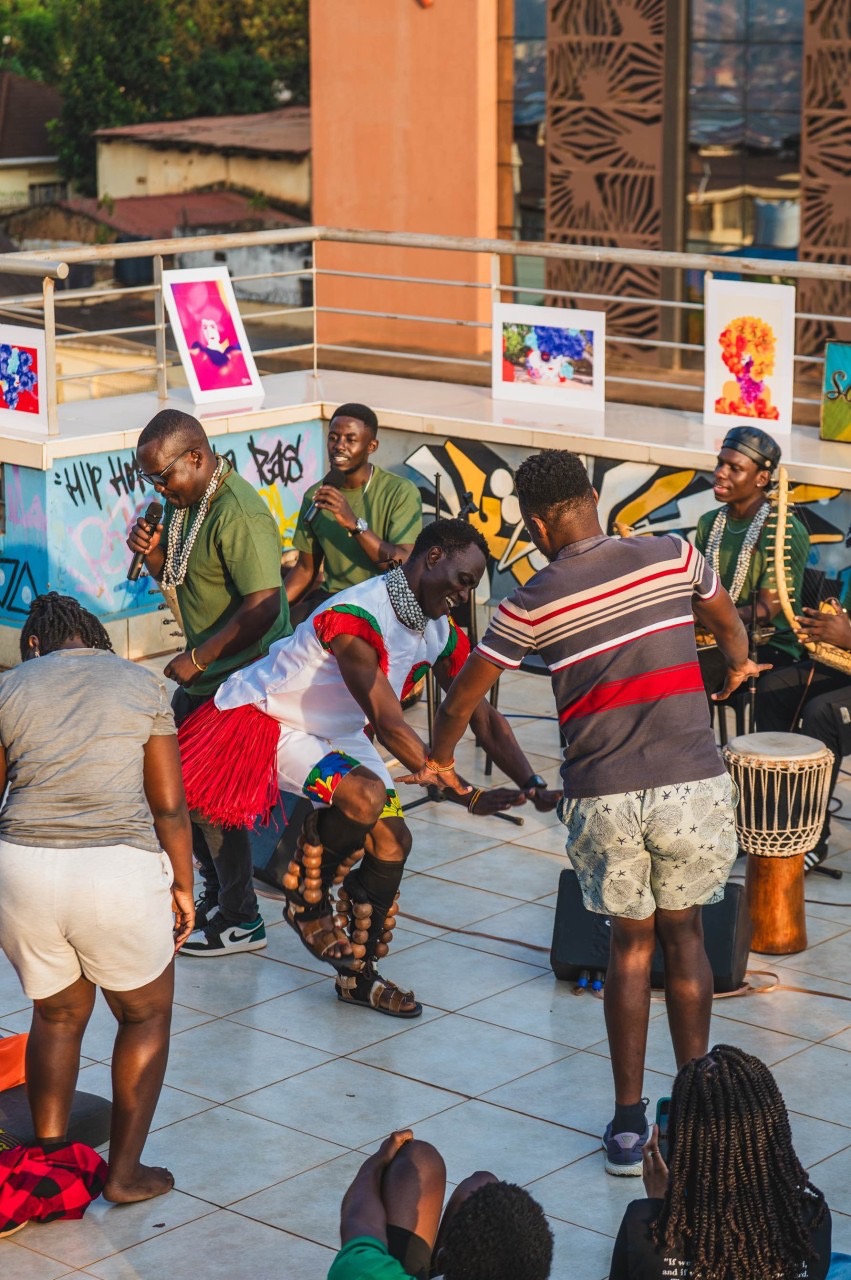
On February 1st, Houda Bakkali’s work was featured at the first cultural event held at the Alliance Française in Kampala, Uganda. The event highlighted SoFar Kampala, a live music festival celebrating diversity, friendship, and creativity within a cultural environment that embraces the fusion of tradition and modernity.
The Alliance Française in Kampala is a meeting place for cultures and a prime example of a forward-looking vision built through education, culture, and innovation.
“It is a great honor for me to have my work in this institution, a true bastion of French culture and heritage. It is an honor to be able to bring my work and creative vision closer to the local community and to share the challenges that innovation and new technologies applied to creativity hold for us,” commented Houda Bakkali.
This event complements Houda Bakkali’s exhibition at the institution’s media library, which was held in November 2026.
Art, Technology, and Science Communication
Art is a powerful vehicle for the transmission of knowledge, the sharing of ideas, and the creation of universal messages that transcend spatial, temporal, and generational boundaries. This capacity becomes particularly significant in the context of health education and public awareness. An artist’s signature, visual language, and recognizable visual identity and cultural presence can serve as an effective framework for conveying expert medical knowledge, validated by leading specialists, and for promoting high-quality information, prevention, early diagnosis, and greater awareness of health conditions.
In the “Breast Cancer Awareness”, dedicated to raising awareness of breast cancer, Houda Bakkali presents a single artwork through multiple versions. It underscores the importance of communicating with rigor, clarity, and impact, fostering prevention and early detection, enhancing understanding of the scientific challenges and advances shaping improved approaches to the disease, and encouraging a perspective that is both realistic and hopeful.
With this new series, Houda Bakkali once again devotes her artistic practice to the integration of art and emerging technologies applied to health, honoring through her work patients, families, and healthcare professionals, and reaffirming her long-term commitment to art as a tool for health communication and social impact.
This series will be one of those that will form part of Bakkali’s artistic proposal in 2026, and it will join other works in which health, science, and technology will take center stage.
Bakkali’s XR practice explores the intersection of art and emerging technologies as a vehicle for knowledge, awareness, and social impact, where the artwork functions as a critical interface rather than an end in itself.
XR x Creativity, Innovation, and Technology in Science Communication
Bakkali’s works integrate physical pieces with animated, interactive, multimedia and immersive formats, following a creative process that brings together traditional artistic practices and advanced technological tools. This hybrid approach expands the reach of the work, increases its dynamism, and strengthens its ability to amplify key messages through a variety of formats and channels that enrich the artwork and connect with audiences in diverse and complementary ways.
“Interactivity and audiovisual media enable a deeper connection between the audience and the artwork. Through immersive experiences, viewers can enter the work’s multiple layers, become an active part of the creative process, and access information in a more engaging and intuitive manner. This fosters meaningful participation, transforming the audience from passive observers into active participants. Such engagement significantly enhances dissemination, as effective dissemination is not only about understanding, but also about participation,” explains Bakkali.
Art and Health
Bakkali’s work integrates new technologies not merely as artistic tools, but fundamentally in the service of medical and scientific information. The capacity to update content in real time, evaluate audience engagement and feedback, adapt the content to different audiences and contexts, and disseminate each artwork without spatial or temporal limitations represents a significant added value to the project’s communicative and social dimension. Through this approach, the artwork moves beyond its aesthetic and emotional dimensions to become a mediated space for content of global relevance.
“Art encompasses everything. Everything exists within art, and art exists within everything. For this reason, translating medical information into works of art enhanced by the unlimited versatility of new technologies transforms the canvas into a high-impact, practical tool for awareness and understanding. It elevates aesthetics to a new dimension: one defined by functionality and the dissemination of scientific knowledge, conveyed through a creative, approachable, accessible, and easily understandable language,” says Houda Bakkali.
Multimedia And Interactivity
Multimedia and interactive content, as well as e-learning formats, enable broader educational reach and add flexibility and versatility to medical communication. It encourages better and clearer prioritization of information and makes it possible to structure content visually, increasing attention and message retention, and resulting in more active information delivery.
In addition to this versatility and the ability to amplify messages through immersive, interactive and multimedia formats, there is also the possibility to update content in real time, as well as evaluate and measure user feedback. All of these aspects are of high value when conveying medical information and sharing health-related content.
The artist’s creativity and personal signature can be the most powerful attraction for capturing the audience’s attention. The artwork is continually reinvented across different spaces and adapts to each format in order to continue conveying its message.
Through A 3D Experience
Virtual spaces such as 3D galleries enable dynamic and immersive access to content, breaking spatial and temporal boundaries. They help amplify messages across multiple platforms and reach wider and more diverse audiences. These tools can effectively complement communication, information, and educational initiatives, enhancing engagement and understanding.
Objective: Art, Science, and Interaction as a Universal Language
With this fusion of art, science, and new technologies, Bakkali’s work seeks to break spatial, temporal, and generational barriers, making art not only accessible and understandable, but fundamentally useful for conveying scientific messages, medical knowledge, and technological advances through rigorous content and across multiple platforms and media, facilitating access, multiplying channels, and encouraging participation.
This dynamic embraces traditional art and all its digital versions, the infinite space of possibilities enabled by new technologies to universalize messages, turning communication into a bidirectional act that is more engaging and playful, more fluid and original.
Art goes beyond the canvas and places the focus on the most human of all sciences: Medicine.
Art and Science Communication
Houda Bakkali brings extensive experience in medical and scientific communication to her artistic practice. Since 2009, she has developed educational and outreach initiatives focused on communication and health, combining interviews with leading medical experts with interactive, immersive, and audiovisual content designed to support the dissemination of science, medicine, and public health.
Her work in health communication has been widely presented at an international level, through both art exhibitions and educational and professional forums. Notably, her project “Art for Health” received the prestigious American Illustration Award in New York (2024), and her work “Creativity against Covid-19”, created for the United Nations #UNCOVID19BRIEF campaign, was honored with the International Motion Awards in New York (2020).
Since 2024, Houda Bakkali’s Art for Health has been a central part of various outreach workshops led by Houda Bakkali and has been exhibited in numerous venues, from the Can Travi Civic Center in Barcelona where it was first presented in an exhibition space to the headquarters of the legendary Alliance Française in Auckland (New Zealand), Phuket (Thailand), Cuernavaca (Mexico) at Colegio Laico, and the Alliance Française in Valdivia (Chile); as well as at the Terrapuerto and the Alliance Française in Trujillo (Peru), and at the campuses of Antenor Orrego University and the University of Piura, in addition to Mall Plaza Piura and the Alliance Française of Piura, among other spaces.
Alliance Française of Dallas Welcomes Houda Bakkali in a Celebration of Art, Culture and Tech
The Alliance Française de Dallas hosts the work of Houda Bakkali in an exhibition in Dallas, United States, marking a significant milestone in the artist’s international trajectory. The exhibition reflects Bakkali’s strong and lasting connection with the United States, a country that has played a key role in her career through outstanding opportunities and emblematic projects.
Presented within one of the institutions that best represents the excellence and cultural legacy of France, where Bakkali’s artistic journey began, the exhibition embodies a powerful fusion of cultures. This collaboration echoes the diversity at the core of the artist’s work and her vision of a future driven by excellence, creativity and limitless innovation.
The exhibition is made possible with the support of Alexandre Rossignol, Director of the Alliance Française de Dallas, and his team, whose dedication and professionalism foster a strong framework for international cultural exchange and artistic dialogue.
Dates: The exhibition will remain open to the public until February 2026.
With this exhibition, the Alliance Française de Dallas reinforces its role as a key platform for Francophonie and international cultural exchange.
“I am honored and sincerely grateful to the Alliance Française of Dallas for the opportunity to present my work and creative vision to its community. I would like to express my sincere appreciation to Alexandre Rossignol, Director of the Alliance Française of Dallas, as well as to his dedicated and highly professional team, for the warm reception of my work, their respect, and their continued support. This exhibition brings together physical and virtual works, extending the artistic experience through augmented reality and allowing art to transcend its traditional boundaries. Creativity is combined with educational outreach, addressing the challenges and opportunities of digital art and its evolving landscape. I warmly encourage audiences in 2026 to visit the Alliance Française of Dallas and engage with its outstanding cultural programming, exemplary hospitality, and exceptional professionals. My sincere thanks for situating my work at the heart of francophone educational excellence and within the cultural context of the United States, a country I greatly, love, admire and respect,” says Houda Bakkali.
VISIT ALLIANCE FRANÇAISE OF DALLAS: 15150 Preston Rd #250, Dallas, TX 75248, Estados Unidos
A Global Cultural Network Meets Digital Art: Houda Bakkali at the Alliance Française
“Novembre Numérique” 2025 is an international initiative led by the French Institute in Paris, dedicated to expanding public access to new technologies and fostering diversity and universal dialogue between creators and audiences worldwide.
Hosted within French embassies, art galleries, cultural centres, universities, shopping centres, and historic spaces, the programme is developed in collaboration with the global network of the Alliance Française.
As part of Digital November, the work of Houda Bakkali was presented simultaneously in 15 cities across 9 countries, forming a unique constellation of interconnected exhibitions. This format redefines the versatility and universality of art through a shared yet plural experience.
The work of Houda Bakkali encompasses a wide spectrum of artistic expressions, ranging from physical artworks to augmented reality, immersive installations to educational content, and from large-scale formats to intimate works, including animations, audio pieces, virtual galleries, and video projections.
While the same artworks are presented across all venues, each exhibition becomes a distinct experience shaped by local audiences, cultures, generations, and contexts, affirming values of freedom, creativity, and diversity.
The exhibition “Digital Art, Digital Culture” by Houda Bakkali demonstrates the capacity of digital art to transcend spatial, temporal, and generational boundaries, generating meaningful synergies between audiences and making art universal, accessible, and intelligible.
Ultimately, the project positions art as a space of creativity, joy, diversity, and cultural exchange, extending beyond traditional limits to become a unifying force art that connects, includes, and endures.
Spanning five continents, Houda Bakkali has exhibited her work in 36 cities across 22 countries through the legendary Alliance Française network.
Houda Bakkali: Empowerment Through Art, Science, and Technology
From October 2 to 31, Barcelona’s Can Travi Civic Center presented the work of Houda Bakkali. The exhibition celebrated beauty, color, movement, diversity, and a hopeful vision of life through the female figure, conceived as a tribute to the artist’s mother. The show was part of the Empodera’t Festival, organized by the Horta-Guinardó District, the Barcelona Institute of Culture, and Barcelona City Council.
Blending physical and digital art, the exhibition pursued a seamless fusion between traditional artistic language and cutting-edge technology. It showcased the transformative potential of digital art and tools such as augmented reality, virtual environments, and multimedia resources to create and disseminate meaning, activate dynamic and bidirectional engagement, and place the audience experience at the center of the exhibition. Creativity transcended spatial, temporal, and generational boundaries.
The exhibition was distinguished by two works that fused artistic expression with new technologies, using them as powerful vehicles for the dissemination of medical and scientific knowledge.
“When new technologies converge with artistic creation, they become an extraordinary tool to disseminate, democratize, and universalize scientific knowledge. In this exhibition, two of my works act as bridges, bringing science closer to the public through creativity. We speak about art in all its forms, and we also share science in all its forms,” — Houda Bakkali
Art, tech & science
The exhibition was distinguished by two works that fused artistic expression with new technologies, positioning them as powerful vehicles for the dissemination of medical and scientific knowledge.
The project by Bakkali highlights the versatility of digital tools in communicating complex medical and scientific content, adapting messages to diverse audiences to ensure clarity, accessibility, and engagement, while promoting high-quality information, prevention, and early diagnosis.
In this context, the canvas emerges as a high-impact communication medium, transforming socially relevant knowledge into an accessible public asset that transcends spatial, generational, and temporal boundaries, while enabling real-time updates and the measurement of communication impact.
GLOBAL IMPACT
Houda Bakkali’s Art for Health has been a central part of various outreach workshops led by Houda Bakkali and has been exhibited in numerous venues, from the Can Travi Civic Center in Barcelona to the legendary Alliance Française in Auckland (New Zealand), Phuket (Thailand), Cuernavaca (Mexico) at Colegio Laico, and the Alliance Française in Valdivia (Chile); as well as at the Terrapuerto and the Alliance Française in Trujillo (Peru), and at the campuses of Antenor Orrego University and the University of Piura, in addition to Mall Plaza Piura and the Alliance Française of Piura, among other spaces.
Arte, salud y nuevas tecnologias
...
El binomio arte y nuevas tecnologías ayuda a trasladar a través de la creatividad de los artistas los mejores contenidos sobre salud firmados y avalados por los mejores especialistas y documentados por fuentes acreditadas. Contenidos medibles y actualizables en tiempo real, cuya dinámica hace que se adapten a cada información abarcando todos los detalles, abiertos a todos los espacios y a todos los públicos. Un enfoque didáctico y comunicativo, también una manera de sensibilizar que va más allá de la estética, aportando utilidad y compartiendo el conocimiento. Haciendo un uso responsable de la tecnología y fusionando el arte con la más humana de las ciencias: la Medicina. El arte humaniza la ciencia, tal y como indica el Dr. Josep Brugada “el arte ha ayudado muchísimo a humanizar la Medicina. Todo aquello que tiene que ver con la expresión artística de la Medicina es una forma de aumentar ese valor humano, ese valor que se encuentra fuera de la propia ciencia y ayuda a entrar más en el ámbito de las relaciones humanas, de las emociones que son absolutamente fundamentales en el ámbito de las relaciones entre las personas y especialmente en la relación entre médico y paciente.”
La red de Alianzas Francesas de Ecuador presenta ‘Arte Digital, Cultura Digital’ de Houda Bakkali
La red de la Alianza Francesa de Ecuador, expone “Arte Digital, Cultura Digital” de Houda Bakkali. La muestra fusiona obras físicas y realidad aumentada, permitiendo al público disfrutar del arte de una manera diferente, más inmersiva, más lúdica y más interactiva. Asimismo, la muestra se complementa con una galería virtual, contenidos multimedia y recursos divulgativos y didácticos sobre arte digital, usos, utilidades y retos.
La exposición forma parte del Noviembre Digital, evento promovido por el Instituto Francés a nivel mundial para promover el arte y la cultura digital y se celebra de manera simultanea en diferentes ciudades de Ecuador: Loja, Cuenca, Portoviejo, Guayaquil y Quito, sumando a la propuesta expositiva encuentros divulgativos con las diferentes comunidades locales y francófonas.
El arte digital y tecnologías como la realidad aumentada, los espacios virtuales y los recursos multimedia, ayudan a potenciar el mensaje, creando una comunicacion dinámica y bidireccional entorno a la obra y a los espacios que la acogen, creando propuestas donde la experiencia del público adquiere especial protagonismo, llevando el arte más allá de la estética, promoviendo el debate y la participacion al rededor de las nuevas tecnologías aplicadas a la creatividad., universalizando, no solo el arte digital, si no también sus herramientas de creación, haciéndolo más cercano, más accesible y más entendible.
Ecuavisa TV | Ecuador
Interview with Dr. Josephine Loftus
I am honored to present my interview with Dr. Josephine Loftus, one of the most respected and renowned authorities in psychiatric medicine. In this conversation, we address the impact of new technologies on human behavior, the importance of communication, the value of happiness, and the role of art in mental health.
In her work as a psychiatrist, Dr. Josephine Loftus has specialized in mood disorders, personality disorders and attention deficit hyperactivity. She has focused on integratiing biological and psychotherapeutic approaches including mindfulness based approaches into her practice. During her time as assistant clinical director in the Department of Psychiatry at the Princess Grace Hospital, Monaco, she established an Alzheimer’s unit, a mood disorders unit, integrated the French network of Bipolar Disorder assessment centers by establishing a diagnostic center in her department. She also initiated psychotherapeutic groups for the treatment of chronic pain, introduced and encouraged training in mindfulness,cognitive behavioural therapy and compassionate focused therapy.
She was made a fellow of the Royal College of Psychiatrist, UK in recognition of her contribution to clinical work and research in psychiatry. She has recently retired from her Hospital position but plans to continue her journey in the field of psychiatry.
Dr. Josephine Loftus stands as a true reference in the field of medicine. It is a privilege to share her insights, those of a distinguished professional and an extraordinary individual: a great humanist, a devoted admirer of art and science in all its forms, and an exceptional communicator.
Interview by Houda Bakkali
What are the main mental health problems currently being diagnosed?
About 1 in every 8 people in the world live with a mental health disorder according to statistics from the World health Organisation (WHO). Mental health issues contribute to approximately 16% of the global disease burden.
Depression and anxiety are the most common mental disorders diagnosed. Depression is one of the leading causes of disability worldwide. The number of people living with depression and anxiety has significantly increased since the COVID 19 pandemic. Post traumatic stress disorder is also on the increase given the growing number of conflicts worldwide where civilians are severely impacted by the violence of warfare and displacement from their homes.
What are the main challenges facing psychiatric medicine?
There are several challenges facing psychiatric medicine. The most important one is lack of resources. Services are underfunded making it difficult to meet the needs of increasingly complex and needy patients. Mental health disorders such as schizophrenia and bipolar disorder begin in the late teens or young adult stage of life and require lifelong psychiatric care in the majority of cases. In the absence of professional treatment, young people can resort to substance abuse as a form of self-medication.
Prevention, early diagnosis and treatment can have a positive impact on outcome and quality of life. Large case loads and the increasing administrative burden means that psychiatrists are unable to provide the regularity of follow-up recommended in clinical guidelines. Mental health professionals also have to deal with more violent situations in the course of their work due to the increase in substance abuse. This is also true for colleagues working in the area of physical health.
Psychiatry is facing a major recruitment problem in many countries leading to a shortage of psychiatrists at a time when they are sorely needed. So, one of the main challenges is trying to plug the gap between what is needed and what is available in terms of care. Psychiatry has long been an underfunded area of medicine and could be said to suffer from the same form of stigmatization as the patients it treats. The increase in anxiety and depressive disorders especially in young people since the COVID-19 pandemic has raised awareness and in some countries lead to promises of increased funding.
More than ever, psychiatrists need to play an active role in education and in raising the profile of mental health problems by lobbying government members. Fondation FondaMentale has shown the way in France. It is a trust devoted to early diagnosis, prevention, psychoeducation and personalized treatment plans which has succeeded in obtaining government and private finance to promote research and raise the public profile of mental illness. We need more dynamic people who do this kind of work.
Another major challenge facing psychiatric medicine and medicine in general is that doctors are not reduced to diagnostic and prescribing technicians who lose the ability to connect with patients and their suffering. In an era where the business model is taking over medicine, where goals and efficiency are of paramount importance and technology is advancing at a rapid pace, it is more important than ever for doctors to remember that they are dealing with a feeling, thinking human being. It is important to maintain the “art “ of medical practice.
Mental health and Psychiatry are not the same thing. How are they related? How do they benefit each other?
Mental health as defined by the WHO is a state of mental well-being that enables people to cope with the stresses of life, realise their abilities , learn well and work well, and contribute to their community. It includes our emotional, psychological and social well-being. The emphasis here is on well-being in all domains which enables the individual to function in all areas of his/her life and to establish lasting and meaningful relationships with others.
Once the balance between these domains of wellbeing is affected, the risk of developing a mental health problem with a significant disturbance in cognition, emotional regulation and behaviour is increased and so is the need for psychiatric follow-up. Obviously, these difficulties will exist on a spectrum of mild, moderate and severe and those at the mild end are unlikely to require psychiatric help.
Psychiatry is the area of medicine which focuses on the diagnosis, treatment and prevention of mental, emotional and behavioural disorders. The ultimate goal of Psychiatry is not just to alleviate symptoms and prescrible medication but to provide a multidisciplinary treatment plan which will enable the patient to recover their mental well-being in all domains. This is not always a straightforward process. In the case of the development of a lifelong chronic illness, the initial starting post of mental well-being and what it means may have to be adjusted through a long process of acceptance of the limitations on personal, social and professional aspirations imposed by the illness. This can also be a difficult process for family members whose mental well-being is also impacted by the patient’s illness. A lot of the work in Psychiatry by mental health professions is oriented towards helping patients find that balance in order to promote well-being and to lead meaningful lives in their communities.
Of course, an individual who meets all the criteria of mental well-being will have more resilience should he/she develop a mental health problem after a traumatic life event and be more likely to make a complete recovery than someone whose mental well-being in one or two domains is fragile from the outset due to an adverse environment in childhood or adolescence.
Many mental illnesses remain a stigma and a taboo for patients. How can we break down these barriers?
Education, raising the public profile of mental illness, challenging stereotypic views of mental illness and most of all getting rid of the divide “us and them.”
This is perhaps the origin of the stigma, the fear that mental illness may affect us too in the way that people were terrified of the plague in the past. The experiences described by people with mental illness are not alien to the population in general. We all know what it is like to suffer profound, paralyzing sadness following a bereavement, a state of euphoria when we fall in love and otherwise healthy people can experience auditory hallucinations. What is different in a person who suffers from mental illness is not the nature of the experience but the intensity, frequency and suffering generated by these experiences. That is what differentiates someone with a mental health problem from a healthy person. It is also important to remember that none of us is immune to developing a mental health problem.
The media plays an important role and has done so in publishing the stories of celebrities who talk openly about their bipolar disorder, substance abuse or depression. The media needs to be more responsible when reporting violence perpetrated by a psychiatric patient. These incidences, although extremely rare, usually get front headline treatment whereas other violent acts committed by criminals with no psychiatric history are relegated to a small paragraph at the bottom of a page. The reality is that the majority of violent crimes are committed by sane people and not by people with a mental illness. Usually when they happen, there is also substance abuse involved which increases the risk of violent behavior.
So, stigma needs to be tackled at a societal level and also at an individual level, beginning with the patient who suffers the most from stigma but who also stigmatizes him/herself because of the illness. This requires a psychotherapeutic approach to enable them to change the way they see themselves and their illness. They can’t control how others see them but they can control how they see themselves. This type of work is often done in a group context with well-established protocols.
Ensuring people with mental health problems have access to a supportive work environment is also important.
There are increasingly more technological applications being implemented in therapies and diagnoses in the field of psychiatry. How do you evaluate this?
These technological applications will improve access to care especially for geographical areas where there is a penury of psychiatrists and other mental health professionals. Tele psychiatry consultations provides access to mental health professionals and crisis support. Telehealth and applications providing cognitive behavioral therapy, enable diagnostic and therapeutic approaches which can transcend geographic boundaries. One AI chatbox tool which delivers cognitive behavioral therapy for depression has been shown to be effective in reducing symptoms of depression and anxiety in clinical trials. Other AI chatbox tools helps connect patients with licensed therapists appropriate to their needs.
Symptom tracking, mood monitoring and behavioral changes can be monitored through apps and can signal changes in mental state and an impending relapse. Immersive exposure therapy through Virtual Reality can help people with phobias and social anxiety who have difficulty travelling to see therapists or carrying out the exercises required to treat their phobias.
Technology allows massive amounts of clinical data to be processed in order to predict changes in mental health and also to identify disease subtypes and disease progression. The data collected can potentially lead to a more individualized approach based on a patient’s pattern and profile as opposed to a one suits all approach.
In theory, these approaches have great potential for increasing access to care, monitoring, symptoms, improving treatment compliance, facilitating diagnosis and the implementation of more personalized treatment plans based on big data analysis.
Some of the approaches seem quite intrusive because of constant monitoring but with a generation who has grown up with smartphones, this may not be a problem. This approach will also give the patient a greater role and more responsibility in the management of their mental health problems which is important.
How does AI impact our mental health?
At one level AI has been described as having a potentially transformative and revolutionary effect on mental health through its capacity to analyze extensive data sets and complex human behaviors. It’s integration into overburdened mental health services could enhance early detection, provide personalized treatment plans, and support offered through innovative platforms could make care more accessible and improve mental well-being. There are also several AI apps to help therapists obtain feedback from patients and better adapt their therapy to patient needs.
So, AI has the potential of having a beneficial effect on mental health. However, there are ethical considerations such as the lack of a comprehensive regulatory framework for the use of AI in mental health, the protection of privacy and the need to preserve the human element. AI should be used as a supplementary tool and not replace the human element in therapy. A recent study from Stanford demonstrated that AI chatbox tools used in mental health failed to pick up on suicide intent. The same study also showed that after exposure to different clinical cases including depression, addiction and schizophrenia, different AI chatboxes showed increased stigma to the cases with schizophrenia.
There have also been recent reports of negative effects of AI on mental health with an increase in psychotic symptoms, increasing dependence on AI, bad decision making based on AI including advice on assisted dying and how to commit suicide when people communicated a feeling of sadness. Although potentially useful in the field of human health, its limitations and dangers need to be recognized.
Technology unites us across distance, breaking down physical and temporal barriers. Is this really beneficial for our minds, or does it merely fuel a fantasy?
Certainly, technology has broken down barriers, facilitated communication and training across time zones and geographical barriers. One out of four adults report being online all of the time. But there are concerns about the effects on our brain structure and function. Evidence from research indicates that technology may have both positive and harmful effects on our brains.
There is evidence that harmful effects of technology may be increased attention deficit symptoms, impaired emotional and social intelligence, social isolation, impaired brain development and a decrease in working memory capacity. The World Health Organisation (WHO) published strict guidelines about children’s screen time use in 2019 based on the results of research. Intensive use was also linked to depression, anxiety and sleep disturbance. Increased screen time in children under age 3 has been linked to poorer early language development, poorer executive functioning and greater sleep problems.
Older children have shown impairments in the recognition of emotions from photographs of facial expression and social cues by comparison with children whose screen time is restricted. There is also the risk of technology addiction. The global prevalence is around 6% with greater prevalence in some areas. Internet addiction is associated with greater levels of attention deficit symptoms, impulsivity and hyperactivity in schoolchildren.
On the positive side it has been shown that certain online tools, programs and videogames can provide mental exercises which activate the brain, improve connectivity between different neural circuits, improve sleep, diminish anxiety and improve memory. One study found that surgeons who played videogames more than three hours per week made fewer surgical errors, had faster responses and better laporoscopic and suturing skills.
Multitasking is one of the consequences of spending a lot of time online and is known to have a negative impact on performance. It is also a skill which declines with age. However, interestingly enough, certain videogames have been shown to improve attention, working memory and the ability to multitask.
So, in conclusion there are arguments for and against technology. It would appear that when targeted programmes and tools are used in a moderate manner, technology may have a beneficial effect. In children, it needs to be used with caution but may be beneficial when accompanied by parent interaction. In other words, technology can be beneficial or harmful depending on how it is used and the particular vulnerability, in terms of age or emotional fragility of the person using it.
What environmental factors have the greatest impact on our mental health?
The social and natural environment both have an impact on our mental health.
In the social environment, different forms of abuse (sexual, physical and emotional) have all been shown to have a negative impact on mental health in adult life and are associated with psychosis, mood disorders and substance abuse. Social isolation, loneliness and lack of a support network have been shown to contribute to depression and poorer physical health in general. On a larger scale, major conflicts affecting civilian populations contribute to the development of post-traumatic stress disorder (PTSD), an incapacitating disorder which can lead to substance abuse and chronic depression.
Major natural disasters such as earthquakes or flooding are also a cause of PTSD. Studies have also shown an association between dense urbanization and the prevalence of mental illness. High population density can lead to chronic stress due to stressors like noise, pollution, crime and incivilities. The number of green spaces and walkable areas would appear to be a protective factor against the development of mental illness.
How does a lack of communication influence our behaviour?
Lack of communication can have an adverse impact on the quality of our relationships with others. Maintaining healthy relationships with others is important for our physical and mental health. Studies have shown that the absence of social relationships has been shown to predict mortality from every cause. Low levels of social support are associated with higher levels of cardiovascular disease.
Lack of communication can be due to physical impairments such as deafness, neurological disorders, psychiatric disorders as in severe forms of schizophrenia and poor social skills.
Lack of communication can impact our behaviour through increased frustration, stress , anger and resentment. Outwardly this can manifest itself as irritability, impatience, perhaps even violent behaviour and social withdrawal. A vicious circle is installed whereby family, friends and acquaintances also withdraw as a protective measure or through exhaustion. This reinforces the feelings of incomprehension, anger and frustration and results in further social isolation and a loss of network. This leads to increased stress and a greater risk of physical and mental illness.
How does psychiatric medicine evaluate optimism?
Dr Rick Hanson, a psychologist, states that human brains are like scotch for negative experiences and Teflon for positive experiences. From an evolutionary perspective, our brains are primed for negative biases in order to counteract potentially dangerous situations. Learned helplessness is a psychological theory of depression based on animal experiments where the animal was deprived of all control over an external stressor. Applied to humans, learned helplessness is a state of mind where an individual after repeated exposure to uncontrollable negative events, believes they are powerless to change the situation even if opportunities exist to do so. The result is passivity, lack of motivation and a sense of hopelessness. Learned helplessness is associated with depression and PTSD. Optimism is the antithesis of hopelessness. Psychiatric medicine is more accustomed to assessing pessimism than optimism.
Rating scales exist to assess dysfunctional attitudes, ruminations, learned helplessness and hopelessness. Few exist to assess optimism. Pessimism is also explored in clinical interviews through exploration of the negative triad in depression-negative attitudes about oneself, the future and one’s relationship with the world. Excessive optimism can also be a problem as in mania where the individual concerned believes everything is possible, to the point of endangering his/her own life.
However studies using the Life Orientation Questionnaire have looked at the relationship between Mental Disorders and optimism and concluded that maintaining an optimistic view reduced the risk of mood disorders, anxiety disorders and alcohol abuse. Optimism contributes to mental health and overall sense of wellbeing. Cognitive behavioural therapy focuses on negative thoughts and helps the individual challenge the validity of these thoughts through reasoning and beahvioural experiments in order to develop a more balanced mental attitude to life. Gratitude journals are encouraged in order to enable patients to note the multitude of minuscule positive situations encountered each day.
The idea is to tilt the brain from a negative towards a more balanced mindset where positive experiences whether they are thoughts, emotions or real life situations have equal salience to negative events.
Social media is a means of communication, but what challenges do they pose for mental health? What would you recommend for healthy use of it?
Addiction, paradoxically social isolation and worsening of conditions such as social anxiety.
Social skills may also be impaired especially in children who depend on an early age on social media for communication. There are also other well mediatized challenges such as on-line bullying which has tragically lead to suicide in schoolchildren.
For healthy use, I would recommend restricted use in children and adolescents and moderate use in adults.
Success and failure: how do they affect mental health?
“Success is not final, failure is not fatal: It is the courage to continue that counts.”(Winston Churchill).
Failure can engender emotional distress and cause depression and anxiety. Not everyone who experiences failure collapses. Protective factors according to studies appear to be higher self-esteem, a more positive attribution style for the cause of failure, and a tendency to be less perfectionistic in order to meet societal values.
Success can have a positive impact on mental health creating a sense of well-being unless the need for success is driven by poor self- esteem and a fear of failure and humiliation. In this case, the drive for success can create chronic stress which in turn can lead to substance abuse, anxiety depression and physical health problems.
You are an expert in mindfulness, among other areas. What does this therapy consist of, and how can it benefit mental health?
Mindfulness is a way of paying attention in a particular way on purpose, in the present moment and nonjudgementally” Jon Kabat Zinn.
Mindfulness is the practice of being fully present and aware of your experiences as they arise, without overreacting or being swept away by thoughts and emotions.
Mindfulness incorporates several practices which include meditation, mindful body movement, mindful walking, mindful eating or being mindful during other daily activities.
The opposite to mindfulness is being on automatic pilot where we are so lost in our thoughts or daydreaming that we are no longer connected to the here and now. All of us have had the experience of driving on a familiar route and arriving at our destination with no recollection of the journey because we were so absorbed in our thoughts. This in itself is not a problem except when automatic pilot takes us down alleyways of dark brooding thoughts and feelings that can eventually spiral into a depressive illness. We are living our lives through the prism of the stories in our mind and not the real experience as it is unfolding.
Jon Kabat Zinn, integrated mindfulness into medical practice through his mindfulness based stress reduction programme (MBSR) for chronically ill patients with intractable pain or cardiovascular problems. The success of his programme has lead to a mushrooming of mindfulness based approaches for physical and mental health problems such as depression, anxiety and substances abuse. It has been shown to reduce relapse rates in addiction and depression and to improve the overall quality of life. Mindfulnnes has been incorporated into psychotherapeutic approaches such as acceptance and commitment therapy, dialectical behavioural therapy and compassionate focused therapy.
Mindfulness practices have also been introduced into the workplace, schools and prisons in order to promote mental well-being and help cope with stress. It improves attention, mood, decreases anxiety and through its non-judgemental approach, encourages a more compassionate attitude towards oneself and others. In a world where constant doing is highly valued, mindfulness reminds us of the value and benefits of non-doing.
Can we talk about a mentally healthy person? What conditions must be met?
We can talk about a mentally healthy person in the same way that we talk about a physically healthy person. A mentally healthy person has good coping strategies to manage stress, is not overwhelmed by negative thoughts and emotions to the point of being paralysed physically and mentally and is capable of maintaining satisfying healthy relationships with others. This does not mean that a healthy person will not traverse periods of sadness, negative thoughts, anxiety and frustration in response to difficult situations such as bereavement, professional and sentimental disappointments but these are appropriate reactions in given situations. We can work at reinforcing our mental health in the same way that we work at improving our physical health through physical activity , time spent in nature and good nutrition. Physical activity has shown to be beneficial for anxiety and depressive symptoms and over the past decade, there has been increasing interest in psychonutrition and the impact food has on our mental health.
A good social network and support is very important. Acts of kindness to others has also been shown to have a beneficial effect on mental health. Loneliness has a deleterious effect on mental and physical health so the importance of social contacts cannot be sufficiently underlined. Having fun whether that be through leisure activities or precious moments with friends and family plays an important part in maintaining our mental health. We should never forget the child in ourselves and the importance of having fun.
What value does art have have in the well-being and recovery of patients?
For thousands of years, people have used art as a means of self-expression, healing and communication.
Art can play an important role in the recovery of patients. It enables patients to express themselves more freely, to connect with their emotions, improve self-esteem and interpersonal relationships. Various art forms have been used as treatment options- theatre, dance movement psychotherapy, music therapy, painting and drawing. Art therapy has been shown to decrease anxiety and promote better regulation of emotions though a better acceptance of emotions. A recent study in the British Journal of Psychiatry showed that women suffering from post-partum depression recovered d sooner if in a singing group as opposed to the control group. Studies have shown greater emotional awareness scores in patients with schizophrenia who were assigned to an art therapy group.
Art therapy can help people cope with stress and despair and diminish the burden of chronic illness. It can contribute to the healing of emotional trauma, enhance awareness of oneself and others, help cultivate the capacity for self-reflection, help generate more appropriate responses to difficult situations and transform behaviours and thinking. Art therapy can be a way for a deeply traumatized patient to express the unthinkable.
Art therapy answers the social, spiritual, emotional as well as the clinical needs of the patient. Let us not forget that the word psychiatry literally means ”medical treatment of the soul.”
The Catalan cardiologist Josep Brugada onces said that happiness is one of the best medicines for cardiovascular health. Does the same hold true for mental health?
Happiness is a state of well-being that contributes to better mental health. Happiness is associated with a reduced risk of chronic illness, better immune function and lower levels of stress. Happiness is often associated with material success, external approbation and validation which can lead to a fleeting sense of joy and pleasure. The happiness that leads to good mental health is related to a more stable core feeling of wellbeing that comes from living a life that has meaning and is in harmony with one’s own values. This may not always be easy but ultimately will be rewarding and provide peace of mind and increase resilience in the face of adversity. Viktor Frankl, a survivor of a Nazi concentration camp illustrated this point in his book ”Man’s Search for Meaning.”
A core feeling of well-being comes from reflecting on what is fundamentally important in one’s life, reflecting through mindfulness or other contemplative approaches on the way the mind functions and one relationship with thoughts and emotions. This not only changes one’s relationship with oneself for the better but also one’s relationship with others. In the society in which we live, people rarely take time to stop and reflect yet as Jon Kabat Zinn, once said of meditation, our life depends on it. Knowledge of ourselves can lead to greater acceptance of our distressing emotions and thoughts as well as the impermanence of things both negative and positive. It enables us to understand what is truly important for us in our lives and live according to those values. Carl Jung, the Swiss psychiatrist talked about the process of individuation as being the ultimate goal of the psychic journey of man. This was viewed by him as not only a service rendered to onself but also to society.
The more we integrated the different facets of our psyche, the healthier and more honest our relationship with ourselves and others become. Cultivating a sense of wellbeing is important as it helps sustain people through difficult situations and promotes physical and mental health. In meditation, there is a practice that uses the mountain as a metaphor. The mountain remains present and true to itself whether it be summer of winter, night or day, lightning and thunder or snow and scorching sun.
La muestra de Houda Bakkali en Guatemala refuerza el impacto cultural y la participación
Con ocasión de la exposición “Arte Digital, Cultura Digital” de Houda Bakkali, en la Alianza Francesa de Ciudad Guatemala se han creado dos cuadernos conmemorativos a través de los cuales los alumnos más pequeños y los más jóvenes de la Alianza Francesa pueden conocer la obra de la artista, sus características, sus valores y lo harán a través de una original variedad de actividades didácticas y lúdicas, poniendo en valor el arte, la cultura y la pedagogía a través de la lengua francesa y acercando a niños y adolescentes al arte y la creatividad en todas su versiones y a través de múltiples juegos.
Un trabajo creado bajo la coordinacion de Timothée Martin y Charline Bled, responsable de la medieteca y las responsables de comunicación y cultura Oceane Garell y Eilalie Loiseau, especialmente diseñados para este evento, en el que se pone el foco en el arte digital a través de los formatos y medios más tradicionales, buscando expandir la cultura, la creatividad y el arte a través de la diversion y de la formación.
“En cada Alianza la experiencia es completamente diferente, comenta Bakkali, cada muestra tiene su singularidad y sus valores diferenciales, estos cuadernos tiene un significado muy especial para mi. Miran al futuro, trasladan el conocimiento y lo hacen a través del color y de la palabra, del juego y de la pedagogía, una manera creativa de avanzar y de acercar a los más pequeños a la creación del presente que solo mira hacia el futuro. Un detalle muy simbólico que, sin duda, aporta un valor diferencial a esta muestra que ha estado absolutamente llena de corazón y de alegría, de mucha implicación, de ganas de hacer y de crecer.”
La muestra “Arte Digital, Cultura Digital” de Houda Bakkali forma parte del Noviembre Digital, evento internacional liderado por el Institut Français para promover las culturas digitales.
Innovación y cultura digital en el Terrapuerto de Trujillo, Perú
Hasta el 31 de diciembre de 2025, el espacio expositivo de la Alianza Francesa de Trujillo, ubicado en el Terrapuerto de la ciudad peruana, acoge la exposición “Arte Digital, Cultura Digital” de Houda Bakkali. La muestra se presenta en un entorno singular, reconocido en múltiples ocasiones como el “mejor terminal terrestre del país” por la Asociación Empresa Peruana del Año, consolidando así al Terrapuerto de Trujillo como un espacio de referencia no solo en movilidad, sino también en dinamización cultural.
La exposición propone una fusión innovadora entre obra física y digital, explorando el potencial del arte contemporáneo y las nuevas tecnologías para romper fronteras espaciales, temporales y generacionales. A través de esta integración, se generan sinergias entre públicos diversos, ampliando el alcance de la experiencia artística y favoreciendo una relación más directa y participativa con la obra.
De este modo, el arte se presenta como un lenguaje atemporal y universal, capaz de acercarse al público de forma accesible, comprensible y festiva, transformando un espacio de tránsito en un lugar de encuentro cultural y reafirmando el valor del arte digital como herramienta de diálogo, reflexión y participación.
+ SOBRE LA EXPOSICIÓN
Bruno Petronilli, nuevo caballero de la Ordre Des Coteaux de Champagne
por Houda Bakkali
“La belleza salvará al mundo”, esa es la frase de Fiódor Dostoievski que eligió Bruno Petronilli para resumir la esencia de la revista que dirige: JamesMagazine.it. Un espacio donde el placer se vive y se disfruta sin remordimientos, entre viajes exclusivos, el mejor Champagne y los grandes vinos. Un recorrido por el arte de la excelencia, porque Bruno Petronilli es la excelencia en estado puro.
Su carrera periodística se inició ligada al Séptimo Arte, aunque pronto se dejó conquistar por el universo de la sommelière y el de la gastronomía más sibarita. Su firma, inconfundible, ha convencido sobradamente a publicaciones de élite como Spirito diVino o las ediciones italianas de Monsieur, Vogue Italia, Il Giornale y Ventiquattro de Il Sole 24 Ore.
Su figura es protagonista en los concursos internacionales de vino, es curador de guías y plataformas especializadas de restaurantes, hoteles y viajes. Ha sido responsable de la Guía de Restaurantes de L’Espresso para la región de Umbría y habitualmente colabora con diferentes concursos y medios, tanto especializados como generalistas, donde comparte lo mejor de la tradición y de la innovación en el ámbito del Champagne, los buenos vinos y la buena mesa.
El milanés caballero de la calidad absoluta como estilo de vida, hoy también es ilustre caballero de la Ordre Des Coteaux de Champagne, un prestigioso reconocimiento que celebra a las personalidades más distinguidas en el ámbito de la cultura y la enología.
Desde 1956 los miembros de la Ordre des Coteaux de Champagne se constituyen como los mejores embajadores de un arte sensorial que busca convencer a todos los sentidos con la exclusividad y la calidad de las mejores propuestas.
El reconocimiento a Bruno Petronilli con esta distinción es el reconocimiento al mérito de una carrera y una vida dedicada a ese noble oficio de comunicar y compartir la excelencia, en todas sus formas y versiones. Un reconocimiento a una trayectoria profesional protagonizada por la profesionalidad absoluta, que está en todos los detalles, que se abre al mundo y acoge lo mejor de cada cultura, universalizando todas las artes a través del poder de la palabra y de la singular comunicación de un buen brindis.
Digital November 2025: Houda Bakkali Bridges Art, Technology and Global Dialogue
“Novembre Numérique” 2025 stands as a major international initiative led by the Institut Français in Paris, committed to expanding public access to new technologies and fostering diversity, innovation and universal dialogue between creators and audiences worldwide.
Deployed across French embassies, art galleries, cultural centres, universities, shopping centres and historic venues, the programme is developed in close collaboration with the global network of the Alliance Française. This extensive framework positions digital creation at the heart of contemporary cultural exchange.
Within this global context, the work of Houda Bakkali was presented simultaneously in 15 cities across 9 countries, forming a unique constellation of interconnected exhibitions. This format redefines the versatility and universality of contemporary art, offering a shared yet plural experience that unfolds across borders.
Bakkali’s practice spans a broad and multidimensional artistic spectrum, from physical artworks to augmented reality, immersive installations to educational content, and from large-scale formats to intimate works, including animations, audio pieces, virtual galleries and video projections. Her work exists across platforms and dimensions, reflecting a contemporary vision of art as fluid, adaptive and inclusive.
While the same artworks are presented across all venues, each exhibition becomes a distinct and localized experience, shaped by audiences, cultures, generations and contexts, reaffirming core values of freedom, creativity and diversity.
Her exhibition Digital Art, Digital Culture exemplifies the power of digital art to transcend spatial, temporal and generational boundaries, creating meaningful synergies between audiences and positioning art as universal, accessible and intelligible.
Ultimately, the project frames art as a space of creativity, joy, diversity and cultural exchange one that moves beyond traditional limits to become a unifying force, capable of connecting, including and enduring in a rapidly evolving digital world.
This marks the second consecutive year that Houda Bakkali has been part of the Novembre Numérique programme, achieving remarkable international impact. To date, her work has been exhibited in 36 cities across 22 countries on five continents, through the Alliance Française network.
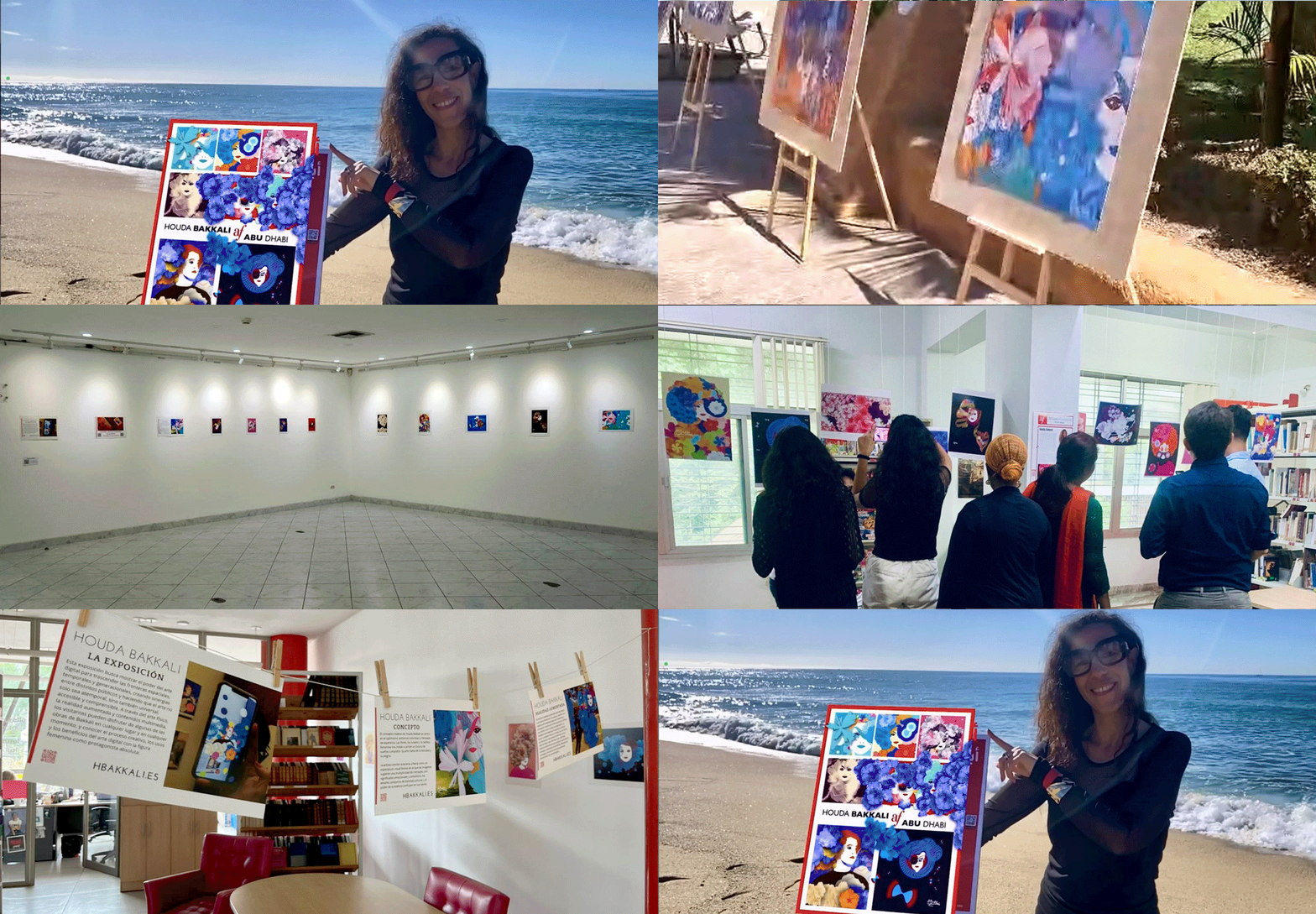
Art, communication and health
Since 2009, Houda Bakkali has been actively engaged in the field of medical and health communication, conducting more than 100 interviews with leading physicians across multiple specialties. Alongside this work, she has developed editorial, multimedia, interactive, VR and AR projects, as well as an AI-based healthcare application, creating communication and educational content focused on health at a global scale. This long-term educational initiative has been recognised with the WIS Certificate (Web of Health Interest).
Her commitment to advancing effective health communication has also been acknowledged internationally. In 2024, she received the American Illustration Award (New York) for her project “Art for Health”, which integrates art and health to enhance clarity, accuracy, and impact in medical communication. Previously, in 2020, her series “Creativity Against Covid-19” was included in the global #UNCOVID19BRIEF campaign launched by the United Nations and was subsequently awarded by the International Motion Awards (New York).
Her work underscores the essential role of communication in healthcare, particularly in supporting patients, families, and medical professionals. By combining new technologies, innovative communication strategies, and creativity, her practice contributes to a more sustainable, accessible, and understandable healthcare ecosystem, pointing toward a future in which technology, communication, and creativity reinforce one another.
Art, tech & science
In 2025, Houda Bakkali developed an innovative project exploring the intersection of art, medicine, and new technologies, presented with great success at the Can Travi Civic Center of the Barcelona City Council.
The project focuses on the versatility of digital tools as a means to convey medical and scientific knowledge, adapting messages to different audiences to make them clear, accessible, and engaging, while promoting high-quality information, prevention, and early diagnosis.
The canvas becomes a high-impact communication medium, transforming socially relevant information into an accessible public asset that transcends spatial, generational, and temporal boundaries, while enabling real-time updates and measurable communication impact.
El arte digital de Houda Bakkali conecta educación, tecnología y cultura en la Universidad de Piura y en la UPAO
Desde el 18 de noviembre, la Alianza Francesa de Piura acoge la exposición “Arte Digital, Cultura Digital” de Houda Bakkali, un proyecto itinerante que ha cosechado un notable éxito de público y participación. La muestra recorre distintos espacios expositivos de referencia de la ciudad, entre ellos la Universidad Privada Antenor Orrego (UPAO), la Universidad de Piura, la sede de la Alianza Francesa de Piura y Mall Plaza Piura, consolidándose como una propuesta cultural de amplio alcance e impacto.
En el marco de esta muestra, Houda Bakkali impartió una ponencia en la Universidad de Piura, centrada en el arte digital, sus retos y oportunidades. Un encuentro dirigido a estudiantes y gestores culturales. Esta actividad formativa refuerza el carácter educativo y divulgativo del proyecto de Bakkali, fomentando el diálogo entre arte, tecnología y cultura digital y destacando la capacidad del binomio creatividad y nuevas tecnologías para acercar el arte digital a públicos diversos, activando espacios divulgativos como puntos de encuentro para la creatividad del futuro.
Una apuesta por la reflexión y la innovación impulsada por la legendaria Alianza Francesa de Piura en el marco del Noviembre Digital, evento internacional del Instituto Française para la promoción de las culturas digital.
Julio Iglesias, un canto a la vida
por Houda Bakkali
Hablar de Julio Iglesias es hablar de un canto a la vida. A esa vida de éxitos y sueños cumplidos, no por el azar, si no por la perseverancia, por la excelencia y la carrera de fondo. Julio ha hecho su carrera, a su manera: única.
Al artista más universal, Manuel Alejandro lo describe como “trabajador acérrimo e incansable, tanto que después de conseguir absolutamente todo con sus cualidades naturales en la creatividad y la interpretación, dedica su vida a perfeccionarlo todo, entregándose a los grandes maestros y a la exhaustiva diaria tarea que llega a superar lo insuperable”. Eso dice un mito de otro mito.
Su voz, reconocida mundialmente, y su estilo, admirado universalmente, se han mimetizado con la profesionalidad de los más grandes, siendo el artista que conquista el mundo cantando junto a Frank Sinatra, Pavarotti, Charles Aznavour, Dalida, Diana Rose, Stevie Wonder y un etcétera interminable. Julio Iglesias ha sido galardonado con innumerables reconocimientos a lo largo de su trayectoria, tantos que tendríamos que vivir otra vida para poder disfrutarlos, asimilar su valor y el esfuerzo que supone llegar a esa cima inalcanzable.
Julio Iglesias es Premio LEGEND en reconocimiento a sus éxitos globales y a su contribución mundial a la industria musical. Es Premio ASCAP Pied Piper, otorgado por la Sociedad Americana de Compositores, Autores y Publicistas, el honor más prestigioso concedido a artistas en Estados Unidos. Es Medalla de Oro de la Sociedad General de Autores en España. Es Premio Artista Latino Favorito. Es Premio Lifetime Achievement Award. Es Premio Vocal Duo of the Year. Es Premio Single of the Year. Es Premio a la Excelencia de la Música Latina. Es Premio de Columbia Records. Es Premio Gaviota de Plata del Festival de Viña del Mar. Es Premio Ondas por su trayectoria internacional. Es Medalla de Oro al Mérito en las Bellas Artes. Cuenta con numerosos Grammy y nominaciones, entre ellas al Best Latin Pop Performance, el Best Latin Recording y el Best Latin Pop Album. Es Caballero de la Legión de Honor de Francia. Es Premio Radio City Music Hall Award al convertirse en el artista extranjero que más veces ha actuado en ese icónico espacio. Cuenta con la máxima distinción musical otorgada por el Gobierno de China, siendo el primer y único artista extranjero en recibirla. Es uno de los artistas más premiados, influyentes y universales de la historia de la música. La historia de Julio Iglesias es, incuestionablemente, la historia del triunfo, el triunfo de la discreción y los méritos propios. La consagración de la clase y la educación en todas sus formas y acepciones.
Hoy su música no suena a nostalgia, si no a la reivindicación de los valores que nos motivan a mirar al futuro con fuerza y esperanza. Su música suena a amistad, alegría, éxito y sueños cumplidos.
A Julio Iglesias le sobran los homenajes, porque su carrera no es una anécdota, si no una leyenda y su mayor reconocimiento es saber que su voz cruza el planeta, símbolo de la universalidad de ese arte auténtico y cercano que une y que no conoce distancias. Julio Iglesias no es una estrella, es un profesional. Es todo lo de antes, es todo lo que viene. Sobre todo: es todo lo que queda. Julio Iglesias canta a la vida. Simplemente con eso ha conquistado todo lo demás y lo ha hecho para siempre y para todos.
L’arte di Houda Bakkali connette il mondo attraverso la creatività e la tecnologia
Dal 1º novembre al 31 dicembre 2025, la mostra di Houda Bakkali, “Digital Art, Digital Culture”, sarà presentata simultaneamente in diverse sedi dell’Alliance Française in varie città e paesi, in un’esperienza che intreccia opere fisiche e virtuali.
Questo approccio permette al pubblico di godere dell’arte in modo diverso, più ludico e interattivo, superando barriere spaziali, temporali e generazionali attraverso le nuove tecnologie e condividendo creatività e innovazione con pubblici diversi. Un chiaro esempio del potere dell’arte di creare sinergie e unire attraverso l’immaginazione, la diversità e la cultura.
Le mostre sono accompagnate da attività e spazi gratuiti, come una galleria virtuale, contenuti multimediali e risorse educative sull’arte digitale, i suoi usi, le sue applicazioni e le sue sfide.
“Digital Art, Digital Culture” di Houda Bakkali sarà presentata simultaneamente in diversi paesi del mondo, un concetto originale e innovativo che l’artista ha introdotto con successo nel 2024 in 11 città di 9 paesi. Quest’anno, il suo progetto prosegue come parte di “Novembre Digitale”, un’iniziativa internazionale guidata dall’Institut Français di Parigi, che mira a valorizzare la cultura digitale e le tecnologie emergenti.
«Il potere dell’arte è illimitato, e le nuove tecnologie amplificano ulteriormente questa unicità. Grazie alla rete unica e immensa di talenti dell’Alliance Française, ho potuto avvicinare il mio lavoro a culture e sensibilità diverse — il miglior esempio della diversità rappresentata da questa istituzione, che vanta oltre 140 anni di eredità e guarda a un futuro di successo e innovazione. La mia più sincera gratitudine va a tutti i cari amici che hanno reso e continuano a rendere possibile che la mia opera prenda vita in tanti luoghi meravigliosi, circondata dai migliori anfitrioni e da un grande entusiasmo nel costruire attraverso l’amicizia, la diversità e il rispetto reciproco. Grazie.» commenta Houda Bakkali.
Queste mostre mettono in risalto la bellezza, il colore, il dinamismo, la diversità e una visione positiva della vita attraverso la figura della donna, come omaggio alla madre dell’artista e al potere femminile. Allo stesso tempo, intendono esemplificare il potenziale dell’arte digitale e di tecnologie come la realtà aumentata, gli spazi virtuali e le risorse multimediali per creare e diffondere messaggi, promuovere una comunicazione dinamica e bidirezionale intorno all’opera e ai suoi spazi espositivi, e favorire proposte in cui l’esperienza del pubblico sia protagonista. Questi strumenti rendono possibile creare e condividere arte ovunque, in ogni momento, in tutte le versioni e per tutte le persone. Creatività che unisce senza limiti.
Attraverso l’Alliance Française, Bakkali ha esposto la sua arte in diversi paesi, tra cui Emirati Arabi Uniti, Arabia Saudita, Bahrein, India, Nuova Zelanda, Indonesia, Sri Lanka, Argentina, Tailandia, Malesia, Stati Uniti, Bolivia, Spagna, Messico, Guatemala, Venezuela, Cile e Colombia. Questo progetto innovativo fonde arte fisica e virtuale, trascendendo i limiti spaziali, generazionali e temporali.
Arte y educación se fusionan en el Colegio Laico de Valdivia con un taller impartido por Houda Bakkali
El pasado 9 de octubre, el Colegio Laico de Valdivia acogió un encuentro artístico y educativo que puso de relieve su compromiso con la excelencia académica, la creatividad y el pensamiento crítico. El taller, impartido por Houda Bakkali, reunió a los niños de esta institución, un público especialmente exigente, curioso y creativo, que confirmó con su implicación el alto nivel que caracteriza al sistema educativo chileno.
Durante la sesión, el alumnado del Colegio Laico de Valdivia demostró una notable disciplina, implicación e ingenio, participando activamente en una experiencia digital e inmersiva que destacó por su enfoque práctico.
Asimismo, la exposición de Houda Bakkali en la Alianza Francesa de Valdivia (AF) también contó con una inauguración virtual en la que Bakkali subrayó a los alumnos la capacidad del arte digital como herramienta educativa y como motor de inspiración, reflexión, diálogo y creatividad en un entorno académico de alto nivel como son el Colegio Laico de Valdivia y la Alianza Francesa, abiertos a la divulgación del conocimiento, al compromiso con el arte y la innovación.
Esta iniciativa, impulsada por la Alianza Francesa de Valdivia, refuerza la importancia de crear espacios donde arte y educación se den encuentro, fomentando experiencias transformadoras capaces de inspirar a las nuevas generaciones.
AQUÍ EL VIDEO
El arte cobra vida en Bogotá: Houda Bakkali presenta “Arte Digital, Cultura Digital” en la Alianza Francesa
Del 17 de octubre de 2025 al 07 de febrero de 2026, la Alianza Francesa de Bogotá presenta en su sede de Chicó la exposición “Arte Digital, Cultura Digital”, de la artista Houda Bakkali. La muestra propone una experiencia innovadora que explora las posibilidades del arte contemporáneo a través de la integración entre creación artística y nuevas tecnologías.
La exposición reúne obras físicas combinadas con realidad aumentada, ofreciendo al público una forma distinta de aproximarse al arte: más inmersiva, más lúdica e interactiva. A través del uso de dispositivos móviles y entornos digitales, las obras trascienden el soporte tradicional y cobran vida, invitando a los visitantes a participar activamente en la experiencia artística.
Como complemento, “Arte Digital, Cultura Digital” de Houda Bakkali, incluye una galería virtual, así como una selección de contenidos multimedia, recursos divulgativos y materiales didácticos que abordan el arte digital desde una perspectiva accesible y pedagógica. Estos contenidos profundizan en los usos, aplicaciones, utilidades y retos del arte digital, acercando al público a las claves de una disciplina en constante evolución y fomentando la reflexión sobre su impacto cultural y social.
La exposición se enmarca dentro de Noviembre Digital, un evento internacional impulsado por el Instituto Francés a nivel mundial, cuyo objetivo es promover el arte y la cultura digital.
Con esta muestra, la Alianza Francesa de Bogotá reafirma su compromiso con la difusión cultural, la innovación artística y el intercambio internacional, posicionándose como un espacio de referencia para la exploración de nuevas formas de creación y difusión en la era digital.
Houda Bakkali X TIME
Inspired by the female figure, vibrant colors, and a hopeful vision of life, the artwork Passionately by Houda Bakkaliforms part of the very first artistic Web3 initiative launched by TIME, the iconic, century-old publication and the first weekly magazine in the United States. Being selected among the first digital artists worldwide for an NFT dropby the prestigious TIME magazine marked a defining moment in the artist’s career.
In September 2021, TIME invited Bakkali to participate in its inaugural Web3 artist program, recognizing her work at a pivotal moment when digital art and blockchain technologies were beginning to reshape the contemporary creative landscape. As part of this pioneering initiative, she presented her work at Dreamverse, the world’s first exhibition dedicated to digital art and Web3 technologies, held in New York City in November 2021.
E-learning y creatividad en la divulgación científica
De los apuntes en un cuaderno, a aprender a través de espacios inmersivos y virtuales. Las nuevas tecnologías permiten diversificar los medios y formatos para hacer una divulgación de la ciencia más eficaz, atractiva y creativa. Los proyectos van creciendo, desde los PDF y publicaciones interactivas y los elementos audiovisuales, hasta los espacios virtuales e inmersivos que nos permiten entrar e interactuar con cada una de las capas y elementos de nuestro trabajo, muchas son las opciones para enriquecer nuestro contenido y trabajar de una manera personalizada nuestros materiales científicos, culturales, etc. Los medios se van sumando, retroalimentando, nos facilitan guionizar la información de maneras diferentes para captar a la atención de la audiencia a través de mensajes fáciles de entender, de procesar, de compartir y de recordar.
EdTech para fomentar la divulgación
Cuando hablamos de divulgación científica, la tarea de hacer entender y hacer participar también conlleva una importante labor didáctica. En esas ventajas que ofrecen las nuevas tecnologías para abordar los contenidos de infinitas maneras y presentarlos perfectamente adaptados a cada entorno, hay que poner el foco en el e-learning. La gamificación, así como el uso de otros recursos propios de la formación online, son grandes ventajas para conectar con la ciencia. De igual manera, la flexibilidad y la ruptura de barreras espaciales y temporales en el aprendizaje, la posibilidad de actualizar contenidos en tiempo real y de aprender de manera colaborativa, hacen del e-learning una opción perfecta para sectores como el médico o el farmacéutico que exigen un aprendizaje y una actualización de información continua.
Las posibilidades que permiten los entornos formativos digitales están en constante reciclaje y evolución, cuentan con un muy amplio abanico de recursos intuitivos y accesibles para que sumar las nuevas tecnologías a la formación tradicional no sea un proceso que requiera de un aprendizaje complejo ni un alto coste en tiempo o en recursos, en este sentido, existen múltiples posibilidades que reducen la brecha digital en este ámbito, tanto si hablamos de plataformas LMS, como herramientas de autor, herramientas de gamificación, de realidad virtual y aumentada, etc.
Diseño intruccional, la piedra angular
Hablar de e-learning exige hablar de múltiples dimensiones, pero, sin duda, una de las más importantes es el diseño instruccional. Su uso es básico y fundamental para jerarquizar el contenido, estructurarlo, darle coherencia y poner el toque creativo a cada pantalla, planteando de manera precisa y didáctica cada elemento, cada contenido y cada recurso para hacer de la formación una experiencia motivadora, fluida y exitosa.
Revisar y actualizar el contenido, procurar los mejores recursos que refuercen el mensaje, crear un diseño donde primen usabilidad, accesibilidad y un extraordinario orden de cada elemento que se vea en la pantalla -diseño en función del contenido-, son sólo algunos de los grandes retos que tenemos por delante los creativos. Ya que el diseño instruccional no sólo es cuestión de arte y creatividad es, fundamentalmente, cuestión de concepto y de capacidad para saber jerarquizar de manera eficaz el contenido, dándole la forma más coherente. Cuando hablamos de contenidos científicos o médicos, aún adquiere más importancia. Independientemente de que hoy muchas herramienta de autor permiten una infinidad de recursos que facilitan el trabajo, la tarea de estructurar nuestros materiales fuente -entendiéndolos perfectamente- es esencial. Una tarea que, en muchas ocasiones, acabamos realizando sobre papel, para luego trasladar y distribuir entre las diferentes pantallas de nuestro curso, al menos en mi caso.
VER VIDEO
El valor del e-learning en la divulgación científica
Los contenidos formativos online comparten las mismas ventajas que muchas otras tecnologías. Aquí el contenido formativo se estructura y facilita enriquecido con todos aquellos recursos que estén a nuestro alcance y al alcance de nuestra creatividad para mejorar el proceso de aprendizaje y también nos permite aprovechar de otros valores como:
- Practicidad: acceder al conocimiento sin limitaciones espaciales ni temporales.
- Uso de elementos audiovisuales e interactivos.
- Personalización del contenido y adaptación a cada audiencia.
- Actualización del contenido en tiempo real.
- Creación de espacios participativos y colaborativos.
- Creación de contenidos en diferentes idiomas.
- Ejercicios, evaluaciones y gamificación para dinamizar el contenido y hacer más creativa y atractiva la formación. Esenciales para la divulgación de la ciencia.
- Trazabilidad. Seguimiento de la actividad de los participantes.
Y un largo etc.
Personalizar el contenido
La creatividad y el sello personal de cada artista permitirá disfrutar de cursos con un valor distintivo. Con una estética reconocible y diferente. La personalización es una de las claves del éxito del e-learning, cada detalle cuenta y cada estilo marca la diferencia. Pero, recuerden, en este caso el diseño va siempre en función del contenido.
El uso de la realidad aumentada
La realidad aumentada es una de las grades aliadas en la formación online y también en la divulgación de la ciencia. Haciendo que los mensajes sean más atractivos, con un enfoque lúdico y didáctico que facilitando el aprendizaje.
De este modo, nos permitirá optimizar la gamificación de nuestros cursos, dinamizar las actividades grupales, crear espacios colaborativos, ver ejemplos y simulaciones de temas técnicos y científicos, participar de una formación a través de entornos inmersivos y multimedia que enriquecen el mensaje.
VER VIDEO
VER VIDEO
Versatilidad, creatividad
En los siguientes curso, he querido ejemplificar esa versatilidad de las nuevas tecnologías para adaptar los contenidos a diferentes contenedores, a diferentes proyectos y audiencias, respetando la idiosincrasia de cada plataforma y de cada medio y buscando una eficacia en el diseño que sea capaz de potenciar el mensaje. De este modo, el proyecto inicial sobre la creación y participación: el uso de la realidad aumentada en la divulgación científica ha ido creciendo: de papel al PDF y publicaciones interactivas, multimedia y contenidos audiovisuales. Después ha cobrado vida a través de la realidad aumentada y ahora aterriza en este contenedor formativo online, tanto en formato de cursos largos como microlearning, valiéndonos de todo el potencial de las herramientas e-learning, de su practicidad y autonomía.
A través del e-learning | Experiencias inmersivas
VER VIDEO
VER VIDEO
Los contenidos científicos exigen rigor y precisión. Los planes de acogida en entornos científicos y médicos son imprescindibles para garantizar un conocimiento rápido, estructurado y eficaz que favorezca la perfecta adaptación a la organización. Representan un signo de calidad, también una hoja de ruta imprescindible que hará de la bienvenida a los nuevos miembros del equipo un proceso más amable, favoreciendo su adaptación a la nueva rutina y disminuyendo sus dudas e inseguridad ante un nuevo contexto. A mayor organización y claridad en los mensajes, más compromiso y motivación.
El e-learning juega un papel clave en este sentido, no sólo en la creación de los planes de acogida, también a la hora de estructurar y fomentar un mejor conocimiento de los procedimientos, las herramientas y protocolos de trabajo. La creatividad es uno de los principales atractivos y valores añadidos del e-learning. Desde el factor clave de un buen diseño instruccional, hasta el impacto de contenidos audiovisuales, publicaciones electrónicas interactivas y multimedia, actividades gamificadas o el uso de la realidad aumentada, no sólo incrementan el interés por el contenido científico, médico y técnico, también fomentan un aprendizaje dinámico, motivador, colaborativo, con un feedback inmediato, una actualización inmediata y una adaptación y crecimiento constante. Un entorno que permite autonomía a través de plataformas intuitivas y con un alto grado de usabilidad, favoreciendo la accesibilidad, rompiendo barreras espaciales, temporales y también generacionales, creando espacios inclusivos donde se atienda a la capacidad de aprendizaje de cada participante analizando sus necesidades, tiempos y competencias, midiendo su progreso con un nivel de personalización total, original y dinámico, a través de la visión y el sello único de cada creativo. Construyendo espacios digitales para la formación a través del arte y la empatía.
Creación y participación: el uso de la realidad aumentada en la divulgación de la ciencia
La divulgación científica tiene el compromiso de hacer entender y también de hacer participar. Informar y diseñar, al mismo tiempo, la hoja de ruta para que esa información sea eficaz. Comunicar y establecer, al mismo tiempo, el orden preciso para que esa comunicación sea eficaz. El binomio creatividad y nuevas tecnologías, sin duda, supone nuevas oportunidades para este propósito. Pero el éxito del impacto visual, dependerá de los factores que han marcado, marcan y -seguramente- marcarán, los principios del buen diseño: el eficaz.
El reto de la creatividad en el ámbito de la divulgación científica no es simplemente ornamental, ni se restringe al estilo del artista, si no que debe fundamentarse en bases innegociables como son una extraordinaria capacidad de jerarquizar la información y una extraordinaria capacidad de transmitir los contenidos a través del arte de lo sencillo, lo claro y lo perfectamente entendible. Cada elemento de nuestro diseño puede o debe tener un propósito, debe estar en el sitio que le corresponde, accesible y listo para cumplir con su finalidad: ser interpretado por el receptor de la manera correcta y deseada. Esto es: accesibilidad, usabilidad, talento creativo y capacidad comunicativa.
De esta manera, cuando hablamos de la versatilidad de las nuevas tecnologías aplicadas a la comunicación visual en el ámbito de la divulgación científica, el éxito de nuestro proyecto dependerá de nuestra capacidad de ordenar el contenido de manera adecuada y en el medio adecuado. Guionizar. Estudiar las necesidades y el perfil de nuestro público, seleccionar los canales apropiados y entender que las herramientas son sólo un medio para un fin: crear. Quizás, éstos pasos puedan ser algunos de nuestros mejores aliados durante nuestro proceso creativo
Mismo contenido, diferentes experiencias
Imaginen que tenemos un material divulgativo impreso, pasarlo a una versión digital, por ejemplo un PDF o un ePub interactivo y multimedia, nos va a permitir enriquecer nuestro documento con videos, audios, interactivos, enlaces, imágenes y, todo ello, con el toque personal del creativo que lo diseña. Nos permitirá actualizar la información y también compartirla y hacer un seguimiento de su uso. Tenemos, por tanto, una herramienta potente, versátil y completa, pero podemos darle otra dimensión más, convertir nuestro PDF dinámico en una experiencia inmersiva que podamos, a su vez, compartir también a través de un simple código QR o un enlace, sin límites espaciales ni temporales. Nuestra composición física ha pasado a una versión digital y ahora adquiere otra dimensión inmersiva a través de la realidad aumentada. Cobra vida y se abre espacio en nuestro propio entorno físico. Se podrá experimentar con ella en cualquier lugar del planeta en cualquier momento, el público podrá entrar en cada una de sus capas y descubrir cada uno de sus elementos. Añadimos aquí el valor diferencial del entretenimiento. El carácter lúdico, participativo y el factor extraordinario de la sorpresa y la curiosidad.
¿Qué más podemos hacer con esta versión de realidad aumentada?
- Cambiar y actualizar los contenidos y elementos de nuestra composición en tiempo real.
- Medir el impacto de nuestro mensaje y evaluar su eficacia.
- Personalizar el contenido. Hacerlo a medida para cada público o cada proyecto.
- Bidireccionalidad. Compartir y colaborar en la creación del contenido.
- Practicar en entornos inmersivos.
- Complementar las narrativas y contenidos tradicionales con versiones inmersivas.
- Dinamizar y crear actividades alrededor de la experiencia inmersiva.
- Interactuar con otras comunidades. Mayor diversificación, más diversidad.
- Crear experiencias, quizás muy únicas.
VER VIDEO
Una nueva ventana para la divulgación de la ciencia
Las nuevas tecnologías nos permiten múltiples posibilidades para crear contenidos que fomenten la participación y el debate alrededor de la ciencia a través de contenidos que también procuren un mayor impacto visual. La realidad aumentada quizás sea una moda que pasará de moda -el tiempo dirá-, pero hoy es una herramienta que, como mínimo, suscita curiosidad en entornos académicos, también en ámbitos como el médico o el farmacéutico. Desde la proyección de aparatología médica en espacios físicos a través simples QR, hasta prospectos médicos, atlas de anatomía humana o campañas de prevención e información sobre determinadas patologías, encuentran en esta tecnología un valor sumatorio que permite crear mensajes que van mas allá del poder creativo.. Del mismo modo, el ámbito de la educación encuentra en la realidad aumentada una manera diferente de conectar con los alumnos, enriquecer los contenidos y dinamizar las actividades en el aula. Sin duda, puede suponer esa nueva ventana para la divulgación de la ciencia.
Ampliar el alcance de nuestro mensaje
Son muchos los valores añadidos que podemos encontrar en el uso de esta tecnología para potenciar nuestros contenidos, pero para que su alcance realmente tenga impacto, la clave del éxito no sólo está en ser fieles, y también leales, a las bases de un diseño eficaz, claro y bien guionizado donde no nos saltemos ningún paso de la pre-producción, de la producción y de la post-producción. Tampoco dependerá de aportar una mayor o menor dosis de creatividad, aunque sí que supondrá un valor diferencial. Realmente, la clave se escribe en plural y se plantea de varias cuestiones. La primera, tener claro para qué necesito crear una realidad aumentada y cuándo hacerlo. En la mayoría de las ocasiones, esta tecnología es sumatoria y efectiva cuando la usamos en campañas. En este punto, es fundamental recalcar la importancia de planificar, planificar y planificar. Crear con un objetivo claro y medible. También hay que plantearse con qué herramienta vamos a crear la realidad aumentada y qué pros y contras nos plantea. Seleccionar con criterio es clave para acertar en herramientas que fomenten la democratización del conocimiento y garanticen la accesibilidad y usabilidad a todos los públicos. Finalmente, tener muy claro que el éxito de nuestro proyecto va a depender en una gran -grandísima- medida de nuestras capacidad de comunicarlo eficazmente. Al igual que ocurre con la divulgación, deberemos hacer entender y hacer participar en este espacio para que no sea una moda, el titular de un día o un experimento en el que invertir tiempo sin lograr entusiasmar y dinamizar a nuestros receptores. De nuevo, debemos crear con el compromiso de conectar con el receptor y hacer que forme parte activa del proyecto.
VER VIDEO
Más impacto visual, mayor participación
De este modo, el impacto visual sumará la creatividad y el sello de cada creativo que se pone frente a la pantalla o folio en blanco, a su capacidad para saber jerarquizar la información, diseccionarla y acercarla de la manera más sencilla y atractiva para promover una comunicación eficaz, una mayor participación.
Multiplicar los canales de divulgación científica con nuevas tecnologías como la realidad aumentada para llegar a otras audiencias a través de experiencias inmersivas y multimedia, va a exigir apostar por la excelencia, la personalización, la responsabilidad -desde cómo presentamos el contendido, hasta el uso de herramientas que fomenten la universalización del conocimiento y faciliten el acceso a todas las personas interesadas- exige crear con tiempo y amor por los detalles, pensando en el reto de alcanzar esa eficacia en los mensajes, en su capacidad para ser entendidos, en su capacidad para ser compartidos. En crear un valor duradero.
La Discovery School de Cuernavaca, acoge una jornada de arte e innovación a través de la obra de Houda Bakkali
La obra de la artista Houda Bakkali protagonizó esta semana un encuentro expositivo en la Discovery School de Cuernavaca, Morelos, donde acercó su obra y su visión del arte contemporáneo a la comunidad educativa a través de la Alianza Francesa. La actividad, concebida como un espacio de exploración, aprendizaje e innovación, permitió a estudiantes y docentes adentrarse en la fusión entre el arte físico y sus múltiples versiones digitales, así como en las posibilidades lúdicas y didácticas de la realidad aumentada más allá del ámbito artístico.
La exposición fue posible gracias al impulso y la colaboración de Amaury Aranda, junto con el equipo de profesionales de la Alianza Francesa de Cuernavaca, cuyo compromiso con la excelencia educativa y cultural hizo de esta experiencia un referente de innovación y creatividad.
Durante la jornada, el alumnado experimentó de primera mano nuevas formas de creación, despertando la curiosidad, la participación y el debate en torno a un futuro sin límites ni barreras creativas. Houda Bakkali destacó el respeto, la implicación y el cariño recibidos por parte de profesores y estudiantes, subrayando el honor de compartir su obra en un entorno académico de excelencia y con quienes están llamados a ser los líderes del mañana.
La artista expresó su agradecimiento a la comunidad educativa y a la ciudad de Cuernavaca, México, por una acogida ejemplar y una hospitalidad excepcional, que reafirman el poder del arte como puente entre culturas, conocimiento y creatividad compartida.
Houda Bakkali, Expanding the Experience of Art
Houda Bakkali’s artworks are the result of a rich creative process that fuses photography, vector illustration, digital collage, animation, and acrylic painting. Each creation is a dual piece: a one-of-a-kind physical canvas paired with an immersive augmented reality (AR) experience. By scanning the artwork, viewers unlock a new, interactive dimension that can be explored anytime, anywhere. This immersive layer brings the piece to life, inviting the audience into a world of movement, sound, and multimedia interaction.
The use of AR adds a dynamic, personalized aesthetic that transforms the canvas into a living artwork, offering an exclusive, sensory-rich journey through its layers, animations, and visual narratives. As boundless as the imagination itself, this immersive dimension makes each viewing experience uniquely engaging and ever-evolving.
The canvas becomes a powerful communicative, informative, and entertainment tool that leverages innovation and creativity to connect with audiences of all generations, without spatial or temporal limitations.
Word Art Day | James Magazine, Italia
Celebrating World Art Day with the very one and only jamesmagazine.it Italia. An unforgettable journey shared with the best friends. I’m deeply honored to have designed two of my most beloved covers for this iconic Italian magazine. Moet & Chandon & Bellavista Wine Forever grateful for all the support and love.
My heartfelt congratulations to the inspiring Bruno Petronilli for creating such a unique space, a celebration of life, authenticity, and dreams fulfilled.
Proud and happy to stand among the best, James Magazine: pure art is jamesmagazine.it
Arte digital en la Alianza Francesa de Mérida, México
Hoy Houda Bakkali ha impartido un taller online de realidad aumentada en la Alianza Francesa de Mérida, México, en el que se ha puesto de manifiesto el papel de esta tecnología como aliada estratégica para potenciar las obras de arte, generar nuevos espacios de divulgación y ampliar la difusión de la cultura.
Durante la sesión, la realidad aumentada se presentó como una herramienta clave para la universalización del conocimiento y el trabajo en equipo, al permitir superar límites espaciales, temporales y generacionales. Asimismo, se destacó su capacidad para complementar las estrategias de marketing y comunicación, mejorar el engagement, orientarse a resultados y generar un impacto positivo en las acciones comerciales.
El taller abordó también los nuevos retos y oportunidades que esta tecnología ofrece a los artistas en ámbitos como el médico, farmacéutico, turístico y educativo, sectores que encuentran en la realidad aumentada una versatilidad atractiva y funcional tanto para usuarios como para el público en general. Se subrayó su potencial para desarrollar acciones medibles, personalizables y personalizadas, así como para crear con inmediatez, actualizar contenidos en tiempo real, diseñar entornos inmersivos, interactivos y multimedia y reforzar una comunicación bidireccional.
A lo largo del encuentro se analizaron el qué, el cómo y el para qué de la realidad aumentada, así como el cuándo y el porqué de su aplicación estratégica. El taller permitió entender el inicio de un arte más allá del arte, posible gracias a entornos digitales bien definidos, bien comprendidos y correctamente aplicados, concebidos desde la planificación y orientados a resultados.
Alliance Française of Bahrain Hosts an Immersive Augmented Reality Experience by Houda Bakkali
The vibrant and expressive work of Houda Bakkali now fills the walls of the legendary Alliance Française of Bahrain, offering the public an immersive experience through augmented reality. Currently on view at the institution’s headquarters, the exhibition can be enjoyed both physically and virtually, allowing each artwork to come to life through augmented reality.
Through this innovative format, Bakkali’s work breaks spatial, generational and temporal boundaries, transforming art into a universal language that connects people through creativity, innovation, friendship and an optimistic outlook. The exhibition introduces a new narrative in which art becomes a two-way communicative, playful and evolving tool, continuously growing through interaction and learning.
Bakkali’s colorful artworks stand as a distinguished witness to the Alliance Française of Bahrain’s extensive cultural and educational programme, which seamlessly combines the promotion of Francophone cultures with local initiatives and international content. This dynamic agenda fosters a passion for literature, theatre, music and cinema, while also reinforcing the institution’s ongoing commitment to knowledge-sharing through talks and conferences on a wide range of topics, including technology, nature, wellbeing, health and gastronomy.
Likewise, this exhibition by Houda Bakkali joins the programme curated by the Alliance Française of Bahrain at the iconic Al-Riwaq, as part of Novembre Numérique the international event led by the Institut français dedicated to the promotion of digital cultures worldwide.
Aliance Française: Rd No 4003, Isa Town, Baréin
Houda Bakkali, beyond Deadly Sins
When art is art. Everywhere, at all times. In all its versions. Here is my series ‘Deadly Sins’, If you could eat a deadly sin, which one would it be?
Houda Bakkali | College of Physicians of Málaga
Presentation to the Mayor of Biarritz Mme. Maider Arostegui | Canvas 1/1 and Augmented Reality | Palais de Congrès Bellevue
Canvas 1/1 and Augmented Reality by Houda Bakkali | Alliance Française Madrid
Houda Bakkali, Can Verdaguer Civic Center
Houda Bakkali: “El arte en el que creo tiene actitud ganadora”
HOUDA BAKKALI: “El arte en el que creo tiene actitud ganadora”
“Yo quiero que mi arte sea lo que es, que el público encuentre lo que espera encontrar”
En el marco del Mes de la Francofonía que homenajea la cultura y la diversidad de los 29 países francófonos y los 300 millones de personas francoparlantes y coincidiendo con el Mes Internacional de la Mujer, Houda Bakkali expone su obra en varias Alianzas Francesas, como la de Auckland en Nueva Zelanda o La Plata, en Argentina, así como en el Festival del Arte y la Cultura – Feria de la Francofonía en la Alianza Francesa de Cuernavaca, México, entre otras sedes. Muestras que unen arte físico y arte digital a través de la mirada femenina. Una fusión diferente entre la tradición y la innovación que el público podrá disfrutar a través de obras impresas y también a través de sus versiones virtuales. Con motivo de este evento, Bakkali nos desvela algunas de sus motivaciones y nos acerca su particular visión del mundo del arte.
Publicado en Barna Diario y Montecarlo News
¿Cuál es tu ideal del arte?
El arte en el que creo tiene actitud ganadora. Está comprometido consigo mismo, sólo así puede ser transformador. Es competitivo y es de méritos propios. Es disruptivo en lo positivo y en lo negativo. Cuando ya lo tienes delante hay que saber bien qué hacer con él, cómo convertir eso en otra cosa que suponga algo, mucho o poco, pero algo. Tiene, también, un trasfondo de peligrosidad que reta a la ignorancia en todas sus formas y al estatismo en todos sus modos. Es valiente, arriesga. Evoluciona continuamente. Conquista lo inimaginable. Se lo propone y, de un modo u otro, por un camino u otro, lo conquista. Es como si todos sus callejones tuvieran siempre una salida. Y eso me fascina.
Hablamos de un proyecto de vida…
El arte se me puso a tiro y no lo dejé escapar. Me gusta, me hace feliz y hasta me permite crear con la ilusión de hacer felices a los demás. Mi carrera es fruto de varias circunstancias. La más importante: la casualidad. Todo me ha ido viniendo por casualidad. Nunca busqué el arte, siempre he pensado que el arte me ha encontrado a mi. El arte tiene el don de la oportunidad, y cuando llega hay que exprimirla al máximo. Al menos, yo así lo hago. Después dejo que mi obra hable, que vaya haciendo, que encuentre su sitio. Y a ver qué pasa.
Sin duda, el arte me ha aportado un proyecto de vida. Me permite crear una nueva historia cada día. Me ha acercado a gentes de todo el mundo, de distintas culturas, religiones, ideologías…, eso es inmenso. Todas las miradas diferentes, las sensaciones diferentes a las que expongo mi obra, me enseñan lo enorme de la vida, del mundo, de la grandeza que existe en las personas, todo lo que nos diferencia y al mismo tiempo nos une en la distancia, en la generosidad, en la escucha y en la conversación.
¿Qué es el éxito para ti?
Para mí el éxito es mucho más que el reconocimiento o la popularidad. El éxito es tener la libertad de hacer lo que yo quiera y cuando yo quiera. Llevar mi obra donde quiera. Crear a mi manera. Estar en los lugares que yo elija y que elija para mi trabajo. Así entiendo el éxito. Llegar a ese punto exige sacrificio, hay que aprender a renunciar, pero merece mucho la pena.
El arte…, ¿muestra o demuestra?
El arte no tiene que demostrar nada. Tiene que descubrir lo que no somos capaces de ver, debe entusiasmar, invitar a reflexionar, remover algo dentro de nosotros o en los demás. En el arte digital se da una circunstancia peculiar, y es que la obra nos descubre lo que vemos y pero no existe. Es como una fantasía hecha realidad pero que es irreal al mismo tiempo. El arte llega a donde quiere, es imprevisible, tiene infinitos caminos para alcanzar metas inimaginables. Ese reto inesperado es lo que más me apasiona. De repente esto. ¿Y ahora qué? Pues eso.
Arte y artificio, es…
El arte es, esencialmente, sacrificio. Todo el artificio que rodea al arte es solo eso: nada. La obra de arte está siempre sola. Los artistas, en gran medida, también. Mi proceso creativo es un momento muy íntimo, pienso en el público y en todas las circunstancias que pueden rodear a mi obra. Creo intentando estar cerca de todo y de todos, pero desde una cercanía muy prudente que no me desvíe demasiado.
¿Qué quieres que aporte tu obra?
Yo quiero que mi arte sea lo que es, que el público encuentre lo que espera encontrar. Quiero que mi obra se disfrute, se entienda y, a ser posible, perdure. A mi arte sólo le interesa aportar buenos momentos. Que sea capaz de acercarse a la gente a través de una mirada optimista, a través del color y de mensajes cotidianos, entendibles y universales: el entusiasmo por la vida, la felicidad, la amistad, la alegría, la confianza, una buena conversación, un reencuentro deseado. El respeto. Sin ofender a nadie, por supuesto. Yo entiendo el arte como entiendo el deporte, si no hay deportividad, se pierde la esencia del deporte y entonces la obra no está completa.
El arte es arte, ¿qué valor añade lo digital?
Para mi el arte digital tiene una esencia muy particular. Nada es igual. Cada día hay algo nuevo. Es un dinamismo descarado, irreverente, imprevisible que me invita a crear con ambición. El arte digital obliga a saber de qué hablamos. Genera oportunidades y también globaliza el acceso universal al arte y a la creación de un nuevo conocimiento. Nos obliga a llevar lo teórico a la práctica. No es de palabras, es de acción y de creación. De saber hacer y que lo hecho sea útil. Nos pone frente al espejo continuamente y pone a prueba nuestro talento. Es una continua ventaja competitiva que retroalimenta nuestra creatividad.
Arte y divulgación, ¿cómo se complementan?
Arte y divulgación son las bases de mi trabajo. El arte es un bien atemporal, un legado que perdura siempre. Si dejo un recuerdo, yo quiero que ese recuerdo sea haber compartido mi obra y haber trasladado el conocimiento de todo lo que la rodea: su proceso creativo, sus herramientas, su utilidad y sus usos más allá del arte. En mi trabajo me gusta ofrecerlo todo y ofrecerlo siempre, todas las versiones, todas las composiciones, todas las historias. Todo el tiempo.
¿En qué consiste tu muestra “Mujeres y arte digital” que ahora mismo está abierta al público en varios países?
“Mujeres y arte digital” es una exposición que forma parte de mi trayectoria artística. Mi musa es mi madre, no hay nada más bonito que rendir homenaje a una madre. Mi obra es mi homenaje a su enseñanza y también es mi homenaje a todas las mujeres que luchan, que sueñan, que crean. A todas nuestras madres, a nuestras abuelas, a su fuerza discreta, a su anonimato que lo protagoniza todo, a su amor por la vida, a su energía imparable, a su serenidad. A ellas, por inspirar el mundo.
Si hablamos de Francia
Francia ha supuesto todo en mi carrera artística. Desde el premio Nuevo Talento que recibí en Cannes en 2018, sin ni siquiera saber que se entregaba un premio en aquel salón de arte donde llegué por casualidad, hasta mis exposiciones en París y en Biarritz donde aprendí todo lo que sé de la trastienda del mundo del arte y donde tuve la oportunidad de acercar el binomio arte digital y realidad aumentada, hasta mis exposiciones en la Alianza Francesa que se han acogido en 16 países, y que hoy es el mejor proyecto de toda mi carrera. Es muy auténtico. Es muy diferente. Es muy útil. Es ese arte que me imagino para siempre, para todos y cada día me suma más motivación, más cariño y más historias bonitas que contar. Un arte que va encontrando sus sitios insospechados. Todos. Hoy aquí, mañana en cualquier parte. Es la magia de lo distinto.
Leer en Barna Diario | Barcelona
Alliance Française Phuket Hosts a Workshop on Art, Technology and Innovation by Houda Bakkali
Houda Bakkali conducted a workshop to the team of the Alliance Française de Phuket, focused on the creative and strategic applications of art and new technologies within cultural institutions.
The session explored augmented reality as a key tool for marketing, communication and audience engagement, emphasizing its potential to enhance cultural experiences, expand institutional reach and foster meaningful connections with diverse publics. Through practical insights into her artistic process, Bakkali highlighted the growing role of emerging technologies in shaping innovative cultural and artistic strategies.

Connect with the Artist: Houda Bakkali Q&A at Auckland’s Art Exhibition
Curious about the possibilities and challenges of augmented reality? The exhibition by Houda Bakkali invites visitors to explore her creative process and gain insight into this innovative technology, its uses, tools, objectives and creative potential.
Hosted by the Alliance Française of Auckland, the exhibition celebrates the beauty of Francophonie through digital art and culture, offering an immersive experience that bridges art, technology and education.
During the exhibition, visitors are invited to leave questions for the artist about the artwork, the creative process, and related topics.
The artist expresses her sincere gratitude to the Alliance Française of Auckland for this exceptional opportunity.
Exhibition Information
Dates: Saturday, 1 March – Monday, 31 March
Opening Hours:
-
Monday to Friday: 9:00 am – 6:00 pm
-
Saturday: 9:00 am – 1:00 pm
Venue: 131 Remuera Road, Remuera, Auckland 1050, New Zealand
Admission: Free
Booking: No booking required
Visitors are invited to simply drop by and dive into the artist’s universe through a tablet provided by the Alliance Française, experiencing the exhibition in an accessible and engaging way.
Una nueva narrativa entre arte y salud a través de la obra de Houda Bakkali
Esta obra ejemplifica el poder del binomio arte y nuevas tecnologías, ayudando a trasladar, a través de la creatividad de los artistas, los mejores contenidos sobre salud, firmados y avalados por especialistas de referencia y documentados por fuentes acreditadas.
Se trata de contenidos medibles y actualizables en tiempo real, cuya dinámica permite adaptarse a cada información, abarcar todos los detalles y estar abiertos a todos los espacios y a todos los públicos. Un enfoque didáctico y comunicativo que actúa también como herramienta de sensibilización, y que va más allá de la estética, aportando utilidad real y fomentando la difusión del conocimiento.
El proyecto apuesta por un uso responsable de la tecnología, fusionando el arte con la más humana de las ciencias: la Medicina. El arte humaniza esta ciencia, tal y como señala el Dr. Josep Brugada:
“El arte ha ayudado muchísimo a humanizar la Medicina. Todo aquello que tiene que ver con la expresión artística de la Medicina es una forma de aumentar ese valor humano, un valor que se encuentra fuera de la propia ciencia y que ayuda a entrar en el ámbito de las relaciones humanas y las emociones, absolutamente fundamentales, especialmente en la relación entre médico y paciente.”
Houda Bakkali participa en “Noche Glitch”, un encuentro de arte digital en Cali
La Alianza Francesa de Cali acoge el encuentro Tertulias Noche Gli+ch, una iniciativa del “Colectivo Lóbulo Frontal” y la Alianza Francesa de Cali que pone el broche de oro a los eventos culturales y tertulias que promueven ambos organismo en la ciudad colombiana junto a artistas locales e internacionales. El acto ha reunido a los creativos que han formado parte de este proyecto en los últimos dos años. Asimismo, ha contado con actuaciones musicales, proyecciones, debates e intervenciones de diferentes artistas.
“El arte que se ve”
Bakkali presentó “El arte que se ve”, una proyección audiovisual e interactiva que nos invita a conocer la versatilidad del arte a través de sus animaciones y los espacios inmersivos. La realidad aumentada conecta con el espectador a través de una ilusión y una recreación de escenarios multidisciplinares que fusionan la creatividad e información, el arte más dinámico con una visión más conceptual y contemplativa dentro de su propio espacio físico. Un arte que acompaña a la palabra y que invita a la reflexión. También a la diversión y a la imaginación. La tecnología se convierte en una herramienta para conectar con la audiencia e invitarla a formar parte de la escena a través de la cercanía y la diversión.
Bakkali ha creado esta pieza simbólica para el cierre de los ciclos creativos y tertulias de la Alianza Francesa de Cali y el “Colectivo Lóbulo Frontal” el laboratorio de creación artística, artes escénicas y digitales más reconocido de Cali y uno de los máximos representantes de las nuevas tendencias culturales en Colombia. Asimismo, el evento rindió homenaje a los artistas que han participado en los encuentros culturales del “Colectivo Lóbulo Frontal” y la Alianza Francesa de Cali a lo largo de estos dos últimos años, así como a la diversidad cultural, creativa y artística como la mejor forma de unión, de inspiración, de libertad y de respeto entre las sociedades.
“El arte que nos acerca en la distancia es un arte generoso. Un arte en el que compartimos nuestra manera de hacer y de sentir. Nuestra visión de la realidad y nuestra imaginación más allá de cualquier límite. Ese es el poder ilimitado del arte y esa es la generosidad de los anfitriones que hacen posible este encuentro entre el talento y la creatividad venida de todos los lugares. Mi más sincero agradecimiento. La Alianza Francesa de Cali y al Colectivo Lóbulo Frontal por su invitación y por su cariño. Es un honor formar parte de este encuentro.” Comenta Bakkali.
La pieza elegida por Houda Bakkali es la “Dualidad del Arte” una obra que ha expuesto en las Alianzas Francesas de Cali y de Cartagena de Indias en Colombia y en la que a través de un nuevo formato que será recurrente en su nueva serie para 2025, busca simbolizar el poder del arte para unir lo homogéneo y lo heterogéneo, creando un círculo perfecto de color y formas voluptuosas, en un claro homenaje a la belleza y a la figura femenina que se fusiona con la naturaleza a través de la versatilidad de la tecnología más vanguardista, conectando así futuro y legado. Durante la presentación, el público también pudo experimentar con la realidad aumentada inmersiva de la obra de Bakkali.
Digital November Showcases Houda Bakkali’s Vision of Art, Technology and Culture
“Novembre Numérique” 2024 is an international initiative led by the French Institute in Paris, dedicated to expanding public access to new technologies and fostering diversity and universal dialogue between creators and audiences worldwide.
Hosted within French embassies, art galleries, cultural centres, universities, shopping centres, and historic spaces, the programme is developed in collaboration with the global network of the Alliance Française.
As part of Digital November, the work of Houda Bakkali was presented simultaneously in 11 cities across 9 countries, forming a unique constellation of interconnected exhibitions. This format redefines the versatility and universality of art through a shared yet plural experience.
The work of Houda Bakkali encompasses a wide spectrum of artistic expressions, ranging from physical artworks to augmented reality, immersive installations to educational content, and from large-scale formats to intimate works, including animations, audio pieces, virtual galleries, and video projections.
While the same artworks are presented across all venues, each exhibition becomes a distinct experience shaped by local audiences, cultures, generations, and contexts, affirming values of freedom, creativity, and diversity.
The exhibition “Digital Art, Digital Culture” by Houda Bakkali demonstrates the capacity of digital art to transcend spatial, temporal, and generational boundaries, generating meaningful synergies between audiences and making art universal, accessible, and intelligible.
Ultimately, the project positions art as a space of creativity, joy, diversity, and cultural exchange, extending beyond traditional limits to become a unifying force art that connects, includes, and endures.
EMPOWERMENT, DEMOCRATIZATION AND SUSTAINABILITY
“The new artistic movements and trends that are digitally based or complemented by the use of digital tools and technologies open up new discussions on sustainability and social responsibility, debates on the need to generate opportunities and create artistic contexts that grow around more accessible, open and equitable principles and spaces, without physical or generational barriers that limit access to art and artistic creation through new technologies. Thinking about the future of art also means thinking about the challenges and the many benefits offered by digital spaces. (…) Art is transformative when it becomes an organic and daily tool for empowerment. Art is transformative when genius and originality inspire emotion and reflection, dialogue and recreation. Art is transformative when its aesthetic and conceptual function transcends spatial, temporal and generational boundaries. Art is a timeless, exclusive and unique luxury, and it is transformative when artists turn it into an accessible, understandable and useful commodity. Art is transformative when it has the unlimited reach and impact of transmitting and sharing knowledge. Art is a matter of form and substance, of imagination and information.”
Houda Bakkali
Houda Bakkali: Digital Creativity Across Bahrain, Saudi Arabia and Abu Dhabi
Houda Bakkali’s digital art project brings together creativity, technology and cultural dialogue through exhibitions presented in Bahrain, Saudi Arabia and Abu Dhabi. These include solo exhibitions at the Alliance Française of Abu Dhabi, Al Riwaq Art Space in Bahrain, and Hayy Jameel Residents – Alliance Française of Jeddah, where her work focused on public engagement with contemporary digital visual culture.
Entrevista al Dr. Aureli Torné Bladé | Nuevas tecnologías y Medicina
Entrevista de Houda Bakkali
Con motivo del Día Mundial Contra el Cáncer de Mama, el Dr. Aureli Torné Bladé, Jefe de la Unidad de Ginecología Oncológica del Hospital Clínic de Barcelona, profesor Asociado Médico del área de Obstetricia y Ginecología de la Facultat de Medicina de la Universitat de Barcelona y académico de la Reial Acadèmia de Medicina de Catalunya, responde sobre los retos en el abordaje de esta patología, el impacto de las nuevas tecnologías en su diagnóstico, la importancia de la prevención y el valor de la comunicación cuando nos referimos al cáncer de mama.
En el ámbito de la investigación científica, ¿en qué momento estamos en la lucha contra el cáncer de mama?
El campo de la investigación del cáncer de mama es dinámico y está en constante evolución, con muchos estudios en curso que prometen continuar mejorando las tasas de supervivencia y la calidad de vida de los pacientes. Los aspectos más destacados son: 1) la detección precoz gracias a los programas de cribado donde las técnicas de imagen siguen mejorando su capacidad para detectar tumores en fases muy iniciales cuyo pronóstico es excelente; 2) tratamientos más personalizados y dirigidos, gracias a los biomarcadores y pruebas genéticas que permiten diseñar tratamientos específicos adaptados a cada tipo de tumor mejorando la eficacia y reduciendo efectos secundarios; 3) nuevos tratamientos como la inmunoterapia que se basa en utilizar el sistema inmune para combatir el tumor y que ha demostrado ser eficaz en un subgrupo de tumores con peor pronóstico; 4) mejorar la equidad del tratamiento del cáncer de mama garantizando que todos los pacientes, independientemente de su ubicación geográfica o sus características socioeconómicas, tengan acceso a la detección, diagnóstico y tratamiento
¿Qué retos nos quedan por delante?
Aunque se han logrado importantes avances en el tratamiento y la comprensión del cáncer de mama, aún existen retos importantes en la lucha contra esta enfermedad, algunos de los cuales son: 1) comprender mejor la resistencia al tratamiento que desarrollan algunos tumores; 2) seguir investigando porque algunos tumores presentan metástasis y recaídas tras un tratamiento exitoso y en algunas ocasiones estas son más agresivas y más resistentes a los tratamientos previos; 3) desarrollar tratamientos menos tóxicos, con menos efectos secundarios y que impacten mejorando la calidad de vida de las pacientes; 4) Seguir avanzando en la medicina personalizada para poder predecir mejor qué tratamientos funcionarán y para qué pacientes, basándose en la genética y biología específica del tumor.
¿Cómo están impactando las nuevas tecnologías como la inteligencia artificial (IA) en el diagnóstico y abordaje terapéutico de esta enfermedad?
Las nuevas tecnologías, y especialmente la inteligencia artificial están mejorando radicalmente el diagnóstico y el tratamiento del cáncer de mama de varias maneras. La inteligencia artificial puede analizar imágenes con un nivel de detalle que supera la capacidad humana lo que mejorará la precisión de las mamografías y otras pruebas de imagen, y por tanto puede aumentar su sensibilidad y favorecer la detección precoz de lesiones. Su capacidad para analizar datos de diferentes pacientes, incluyendo información sobre todas las variables biológicas, clínicas y de respuesta a tratamientos previos puede ayudar a identificar qué tratamientos serán más efectivos para un paciente específico. En definitiva, la inteligencia artificial puede apoyar las decisiones clínicas al integrar y analizar grandes volúmenes de información médica, desde protocolos clínicos hasta las últimas investigaciones y datos de ensayos clínicos, facilitando al médico el acceso a información relevante y actualizada en tiempo real.
Un estilo de vida saludable, ¿en qué medida ayuda a prevenir el cáncer de mama?
Mantener un estilo de vida saludable es esencial en la prevención del cáncer en general y también en el cáncer de mama. Por ejemplo, hay evidencia sólida que asocia el sobrepeso y la obesidad con un mayor riesgo de cáncer de mama y especialmente tras la menopausia ya que el que tejido adiposo aumenta el nivel de estrógenos y promueve la actividad inflamatoria. También el consumo de alcohol está claramente vinculado a un aumento en el riesgo de cáncer de mama, por lo que se recomienda limitar su ingesta o evitarla completamente. Respecto a la actividad física regular, numerosos estudios han mostrado que puede reducir el riesgo ya que también ayuda a mantener un peso saludable, reduce la inflamación y mejora la regulación hormonal. En definitiva, implementar un estilo de vida saludable, aunque no garantiza la prevención del cáncer de mama, pero si puede disminuir significativamente el riesgo.
¿Qué papel ocupa la comunicación en el abordaje de la enfermedad?
La comunicación desempeña un papel fundamental en el abordaje del cáncer de mama, impactando en múltiples aspectos. Es importante educar al público y para ello las campañas de salud pública bien diseñadas pueden aumentar la conciencia y motivar a las mujeres a participar en programas de cribado o adoptar estilos de vida más saludables. Además, la comunicación en la atención de las pacientes con cáncer de mama es esencial para asegurar que entienden su enfermedad, las opciones de diagnóstico y tratamiento, comprendiendo los beneficios y riesgos de cada opción y facilitando su toma de decisiones informadas. La comunicación empática y el apoyo psicológico son fundamentales para las pacientes y sus familias ya que les ayuda a manejar el estrés, el miedo y la incertidumbre asociados con la enfermedad.
Un mensaje esperanzador para las pacientes y familiares.
Todos los avances en la investigación y los tratamientos a los que nos hemos referido nos acercan a un futuro en el que el cáncer de mama se está convirtiendo en una condición completamente manejable con mejoras continuas y progresivas en todos los ámbitos (detección, diagnóstico, tratamiento) lo que se refleja en excelentes resultados y auguran un futuro esperanzador para las pacientes y sus familias.
Fuente de la imagen: Hospital Clinic de Barcelona
Arte, divulgación y salud en el octubre rosa
El arte y las nuevas tecnologías abren nuevas posibilidades a los creativos y a la sociedad en general y también permiten trasladar la información sobre salud y medicina sobre prevención y diagnóstico precoz, así como concienciar y sensibilizar, desmitificar y trasladar la comunicación médica a través de la creatividad y de los inagotables recursos del arte digital con una visión única, la visión de cada artista. Como cada año, este es mi homenaje a la fortaleza de pacientes y familiares, a la labor de los médicos, profesionales sanitarios, investigadores, científicos y divulgadores en su labor de luchar, curar, cuidar, informar y concienciar sobre el cáncer de mama.
Durante muchos años he desarrollado campañas divulgativas sobre comunicación y salud, muchas de ellas específicamente enfocadas al cáncer de mama. En estas campañas, los objetivos han sido siempre: ayudar a la prevención, fomentar el diagnóstico precoz, promover información de calidad de mano de los mejores expertos en oncología y desmitificar la enfermedad. Hoy, el binomio creatividad y nuevas tecnologías, como la realidad aumentada, suponen herramientas de alto valor didáctico y pedagógico, y cada día se introducen más en el campo de la medicina.
El arte y las nuevas tecnologías abren nuevas posibilidades a los creativos y a la sociedad en general y también permiten trasladar la información sobre salud, sobre prevención y diagnóstico precoz, así como concienciar y sensibilizar, desmitificar y trasladar la comunicación médica a través de la creatividad y de los inagotables recursos del arte digital.
El arte, sumado a las nuevas tecnologías, se traduce en una excelente herramienta de información, de concienciación y de divulgación. También, es una excelente herramienta para transmitir mensajes esperanzadores. El arte y la tecnología se deben unir para promover de manera continuada contenidos que fomenten hábitos saludables, que ayuden a la prevención y al diagnóstico precoz y que también ayuden a hacer una mayor y mejor divulgación de los contenidos médicos y científicos. El arte digital va más allá del arte y a ese valor debemos sacarle el máximo partido. Los avances de la inteligencia artificial conllevarán grandes avances también para la medicina, se podrá hablar de una medicina personalizada gracias al mejor manejo de grandes volúmenes de datos, entre otros aspectos. Por su parte, la realidad aumentada actualmente ya está cumpliendo una función didáctica e informativa muy importante en la medicina: desde prospectos médicos, hasta atlas anatómicos, son presentados a los especialistas, pacientes o estudiantes para hacerles mucho más amena la información y crear un aprendizaje más fluido, más divertido, donde la creatividad es protagonista, con la posibilidad de actualizar la información en tiempo real, de compartirla sin limitaciones espaciales ni temporales y de trabajar con contenidos multimedia, además de la trazabilidad y la monitorización de la información que nos permiten estas herramientas. Son herramientas potentes, muchas de ellas muy accesibles e intuitivas.
Hoy recopilo algunas de estas campañas divulgativas y entrevistas que he tenido el honor de realizarle a algunos de los mejores médicos de España y sumo mi obra de arte como homenaje a todas las mujeres valientes, a sus familiares y a los especialistas que hacen de la Medicina la más humana de todas las ciencias. El arte y las nuevas tecnologías, también son una excelente herramienta de información, de concienciación y de divulgación. Una herramienta para trasladar un mensaje esperanzador.
Houda Bakkali Exhibits in Saudi Arabia
The Alliance Française of Saudi Arabia presents Happiness, an exhibition by Houda Bakkali hosted by Alliance Française at Hayy Jameel.
The exhibition brings together physical artworks, digital media and augmented reality, proposing a hybrid exhibition model that examines the integration of emerging technologies within contemporary artistic practice. Through this approach, the project explores how digital tools can expand traditional exhibition frameworks and support new forms of access, interpretation and public engagement.
Designed as a multidimensional exhibition format, Happiness analyzes the capacity of digital art to operate across different spaces and contexts, facilitating cultural exchange and learning among diverse audiences beyond spatial, temporal and generational boundaries.
The project is complemented by educational and interpretative content that contextualizes the applications of new technologies in art, positioning digital media as tools for visual communication, mediation and knowledge dissemination. This framework encourages audiences to engage with creativity not only from an aesthetic perspective, but also as a mechanism for understanding contemporary cultural and technological processes.
Through this initiative, the Alliance Française of Saudi Arabia reinforces its role as a platform for the presentation of contemporary artistic practices and for the promotion of digital culture within an international and educational context.
Entrevista con el Dr. Josep Brugada: medicina, arte y deporte
Dr. Josep Brugada: El mejor tratamiento que tenemos para cualquier patología, no solamente el corazón, es la felicidad
Entrevista Houda Bakkali
“El arte ha ayudado muchísimo a humanizar la Medicina. Todo aquello que tiene que ver con la expresión artística de la Medicina es una forma de aumentar ese valor humano.”
“La realidad aumentada y la realidad virtual nos ayudan a visualizar cómo hacer determinadas intervenciones, cuál es el mejor elemento tecnológico para cada enfermedad o trastorno en pacientes concretos.”
“No hay que temer a la inteligencia artificial. Muy al contrario, va a ser de una ayuda muy importante tanto para la cardiología del deporte como en tantos otros campos.”
“Los desfibriladores son, sin duda, los elementos clave para salvar vidas.”
————–
A pocos días de que den comienzo las Olimpiadas de París, tengo el honor de entrevistar al Dr. Josep Brugada y conversar con él sobre el impacto de las nuevas tecnologías como la realidad aumentada o la inteligencia artificial en la medicina deportiva, especialmente en su impacto sobre la cardiología. También conocer su opinión sobre el papel del arte en la Medicina, la más humana de todas las ciencias, y saber qué papel ocupa la felicidad en nuestra salud global.
El Dr. Josep Brugada es uno de los referentes de la cardiología mundial y una de las voces divulgativas más respetadas y queridas. Consultor sénior del Hospital Clínic de Barcelona y Director de la Unidad de Arritmias Pediátricas del Hospital Sant Joan de Déu de Barcelona, describió en el año 1992, junto con sus hermanos, la enfermedad causante de la muerte súbita cardiaca que hoy lleva su nombre, el Síndrome de Brugada. Es uno de los especialistas pioneros en la aplicación de las técnicas y las tecnologías más avanzadas en el tratamiento y la prevención de patologías cardiacas. Su labor pedagógica, divulgativa e investigadora queda plasmada en más de 500 artículos en las revistas internacionales más importantes en medicina y cardiología. Con una trayectoria reconocida con prestigiosos premios en todo el mundo, el Dr. Josep Brugada, también ha dirigido el equipo de cardiología deportiva del Fútbol Club Barcelona y es uno de los máximos precursores de la implantación de los desfibriladores en espacios públicos, privados y, muy especialmente, deportivos.
————–
Estamos a las puertas de las Olimpiadas de París, el acontecimiento deportivo más importante, ¿qué es esa disciplina llamada cardiología del deporte y cómo prepara el corazón de un deportista?
Entendemos por cardiología del deporte aquella parte de la especialidad de la cardiología que se ocupa -a priori- de la gente sana que son los deportistas para poder ver que, efectivamente, su corazón está preparado para aguantar el esfuerzo que representa hacer deporte a distintos niveles y que, por tanto, se va a adaptar en función del tipo de deportista. No es lo mismo lo que vamos a ver en un deportista que hace deporte ocasional y recreativo que en uno que hace deporte de residencia continuada como maratones, ultra maratones, etc. Lo que buscaremos será distinto.
¿Qué se busca en cada caso?
En un caso queremos saber que su corazón está en un estado adecuado para hacer ese ejercicio y que va a responder bien y en otro vemos cuáles pueden ser las consecuencias para su corazón a la hora de realizar un deporte intenso y continuado. Por tanto, ahí la cardiología buscará aspectos distintos para poder hacer que esa persona pueda hacer el deporte que quiera de la forma adecuada.
¿Qué impacto tiene la inteligencia artificial en la medicina deportiva?
La inteligencia artificial, sin duda alguna, está entrando en todos los ámbitos de la salud y puede ser una ayuda inestimable para elementos que requieren de mucha protocolización. Por ejemplo, en el análisis de los electrocardiogramas puede ser una gran ayuda porque la inteligencia artificial ve y analiza todos los aspectos que nosotros le hemos enseñado y nos devuelve esa información sintetizada y organizada de tal manera que la podamos usar. Pero no nos olvidemos, que al final quien va a hacer el diagnóstico y quien va a tomar las decisiones siempre va a ser el médico. En la cardiología del deporte la inteligencia artificial puede sistematizar la forma en la que nosotros atendemos a un paciente. Puede hacer ver o recordar, todos los aspectos, algunos de ellos pueden ser extremadamente infrecuentes. También para que gente con menos experiencia en determinados aspectos tenga en la inteligencia artificial una ayuda para recordarle todas las posibilidades, todos los elementos clave para llegar al diagnóstico y al manejo adecuado de cada uno de los pacientes.
¿Cree que hay que temer a la inteligencia artificial?
No hay que temer a la inteligencia artificial. Muy al contrario, va a ser de una ayuda muy importante tanto para la cardiología del deporte como en tantos otros campos.
¿Qué deporte y para qué corazón?
El deportista es por definición alguien sano, que se está cuidando y que, por tanto, nuestro papel como médicos es acompañarle y aconsejarle en función del estado de su corazón. Lo primero que debemos es asegurarnos de que su corazón esté sano. Por ello, se hacen las exámenes “pre deportivos” en donde se evalúa que, efectivamente, el estado cardiológico de esa persona es apto para hacer deporte. Pero, sobre todo, en el seguimiento de esa persona una vez que empieza a realizar deporte. Hacer un seguimiento de alguien que haga deporte continuado de resistencia e intenso, no todas las personas van a adaptarse a ese deporte intenso. En algunos casos sabemos que el corazón puede mal adaptarse a ese ejercicio intenso y eso es algo que tenemos que controlar y eso lo hacemos en las revisiones periódicas en las personas que realizan deporte de resistencia para estar seguros de que su corazón está soportando bien ese esfuerzo realizado. Ahí es donde el cardiólogo puede dar los consejos sobre hasta qué punto de intensidad puede llegar esa persona.
Los desfibriladores cobran una gran importancia en el deporte, ¿hasta qué punto salvan vidas?
Los desfibriladores son, sin duda, los elementos clave para salvar vidas. Una persona que tenga una muerte súbita cardíaca, por lo que llamamos una fibrilación ventricular que es la arritmia más frecuente que provoca la muerte, sólo hay un elemento capaz de revertir esa situación en los minutos que siguen al evento que es disponer de un desfibrilador automático. El desfibrilador va a permitir recuperar el ritmo normal y recuperar la vida de esa persona si lo utilizamos en esos 10 o 15 minutos iniciales después del evento arrítmico. Por tanto, disponer de desfibriladores semiautomáticos o automáticos en todas las instalaciones deportivas y en los lugares públicos en general permite salvar vidas. Hay muchos estudios en el mundo que evidencian que cuantos más desfibriladores estén disponibles, más vidas vamos a salvar porque vamos a llegar a más pacientes que han sufrido una muerte súbita inesperada. Por lo tanto, al igual que vemos extintores en prácticamente todos los lugares públicos, deberíamos tener también una red de desfibriladores de utilización pública que todo el mundo pudiera utilizar para poder salvar la vida de una persona.
¿Es la tecnología la aliada perfecta de la Medicina?
La tecnología nos ayuda muchísimo, nos está permitiendo hacer cosas absolutamente extraordinarias en el tratamiento de pacientes con distintas patologías cardiacas. Por tanto, somos muy afortunados de vivir esta época en donde este boom tecnológico fantástico nos permiten, prácticamente, identificar y curar cualquier patología cardiaca.
La realidad aumentada y la realidad virtual, ¿cómo impactan en la práctica cardiológica?
La realidad aumentada y la realidad virtual nos ayudan a visualizar cómo hacer determinadas intervenciones, cuál es el mejor elemento tecnológico para cada enfermedad o trastorno en pacientes concretos. La realidad virtual nos permite reproducir en el laboratorio, antes de hacer la intervención de una determinada patología y buscar y ver exactamente cuál sería el mejor tratamiento. Esto va a aumentar exponencialmente en los próximos años con la inteligencia artificial pero también con lo que es la impresión 3D, la reproducción de toda la información fuera del cuerpo del paciente, etc.
Usted me dijo hace tiempo que la Medicina es la más humana de todas las ciencias, en un contexto tan invadido por la tecnología, ¿sigue siendo así?
La Medicina es la más humana de todas las ciencias y así debe continuar. El hecho de que estemos en una vorágine tecnológica, de realidad virtual, de inteligencia artificial…, no debería hacer perder esa parte fundamental de la Medicina que es la relación humana, la relación entre médico y el paciente, donde además de hacer la labor científica le dé el soporte humano para ayudarle a entender lo que le pasa y a confiar en que la Medicina y el médico le van a ayudar.
¿Cree que el Arte ayuda a humanizar la Medicina?
El arte ha ayudado muchísimo a humanizar la Medicina. Todo aquello que tiene que ver con la expresión artística de la Medicina es una forma de aumentar ese valor humano, ese valor que se encuentra fuera de la propia ciencia y ayuda a entrar más en el ámbito de las relaciones humanas, de las emociones que son absolutamente fundamentales en el ámbito de las relaciones entre las personas y especialmente en la relación entre médico y paciente.
Para tener un corazón sano, ¿de qué no me tengo que privar?
Esta es una muy buena pregunta porque, en general, a los cardiólogos se nos pregunta siempre qué es lo que no puedo hacer y usted me pregunta de qué no me tengo que privar. Pues no me tengo que privar de intentar ser feliz, de intentar tener una vida sana, de comer adecuadamente de hacer un poquito de ejercicio físico cada día, pero sobre todo de tener unas buenas relaciones humanas, una buena relación con mi entorno, con mi familia, con mis amigos, de disfrutar de las cosas del día a día. Probablemente, son la mejor medicina para nuestro corazón. Eso incluye un vasito de vino bueno con los amigos, disfrutar de una buena comida, no por la comida en sí, si no por la compañía, por disfrutar de esos momentos que nos hacen felices en el día a día.
¿Es felicidad la mejor medicina?
El mejor tratamiento que tenemos para cualquier patología, no solamente el corazón, es la felicidad. Que alguien sea feliz, esté bien consigo mismo a pesar de tener una enfermedad, el que esté confiado en que le están tratando bien, que se sienta querido por sus amigos, por sus familiares, por los médicos, etc., esa actitud de positivismo hacia todo lo que le envuelve es lo que permite que aceptemos bien las situaciones y que ayudemos a un buen cuidado físico y emocional de nuestro corazón.
Comisión Europea: más allá del arte digital
Arte y nuevas tecnologías se sumaron en la pasada edición de la 83ª Feria del Libro de Madrid de la mano de Houda Bakkali. Un encuentro organizado por la Comisión Europea en España y La Alliance Française de Madrid que tuvo lugar en el Pabellón de Europa y en el que el público pudo acercarse a los retos y oportunidades que plantean espacios como la realidad virtual, la realidad aumentada, la inteligencia artificial o la Web3,. Más allá de los conceptos y los ejemplos prácticos, los asistentes pudieron ver algunos de los usos y utilidades de estas tecnologías más allá del arte y su versatilidad para romper barreras espaciales, temporales y generacionales.
Ha sido un gran honor representar a la Alianza Francesa de Madrid (AF) en el marco de su 40 aniversario en un evento tan importante que cada año acoge lo mejor de la cultura en la capital de España. Un evento que organiza la Comisión Europea bajo el lema “Unida en la diversidad”, una idea que simboliza a la perfección la diversidad, universalidad y versatilidad de ese binomio arte y nuevas tecnologías, y también el alma de la Alianza Francesa. Estoy muy agradecida a AF y a la Comisión Europea por su invitación”, comenta Bakkali.
Durante la presentación, los asistentes pudieron realizar un viaje por el arte digital. Viendo las posibilidades que ofrecen sus múltiples plataformas para llevar la creación artística al campo literario, educativo, médico, cultural, etc.
“Sumar arte y nuevas tecnologías también sirve para potenciar y optimizar contenidos, hacerlos visualmente más impactantes, jerarquizar a través de ellos la información de manera más didáctica y también más lúdica, potenciar nuevas formas de comunicación y optimizar las estrategias de marketing con herramientas que permiten un mayor control sobre el contenido, mejor seguimiento y actualización en tiempo real. Una mayor personalización y una trazabilidad que ayuda a crear mensajes de más y mayor alcance”, dice Houda.
La suma de arte y nuevas tecnologías también permiten acercar la cultura al público de una manera mucho más cercana, apostando por nuevos formatos, más divertidos, con una continua capacidad de reciclaje y con altas dosis de interactividad. “De lo teórico pasamos a lo inmersivo y envolvente -dijo Bakkali-. Estos nuevos ecosistemas nos permiten acercar el arte, la literatura, la cultura, en general, la ciencia, y cualquier disciplina, de múltiples maneras, pero con un nexo en común muy importante: el público, a quien se implica no sólo en el mensaje, también en su creación, pasando a formar parte directa y protagonista. Lo cual ayuda a acercar nuestro mensaje, hacerlo entendible, recordable y participativo”, dice Houda.
Uno de los principales ejemplos que aportó el artista para ejemplificar el uso y utilidad de la realidad aumentada en medios editoriales fue con la icónica revista italiana James Magazine. Una portada con la marca Möet que cobra vida y transmite al público no sólo la excelencia de James, sino también la narrativa del emblemático champán francés.
Durante la presentación en el Pabellón Europa, Bakkali hizo alusión al potencial de la realidad aumentada en diferentes sectores como el artístico, el educativo o el médico. “Actualmente tengo dos exposiciones activas. Una en la AF de Abu Dhabi y otra en la AF de Nueva Delhi. En ambas el arte digital y los múltiples formatos que estoy presentando se complementan y se retroalimentan. Me ayudan a trasladar mi mensaje de manera dinámica, romper estereotipos, visibilizar mi obra protagonizada por el poder femenino y por la figura de la mujer árabe, compartir herramientas de creación y de difusión de la creatividad, experimentar con espacios virtuales artísticos que, a su vez, acogen múltiples mensajes sobre arte y cultura digital.
En Abu Dhabi y en Nueva Delhi el público podrá acceder a esta presentación de hoy en Madrid de una manera distinta, sumergirse en ella a través de diferentes medios, sonidos, imágenes, conocer a sus protagonistas, incluso aportar sus ideas, ampliando y enriqueciendo el debate sin barreras espaciales ni temporales ni generacionales. Podremos hacer que se sorprendan, que se diviertan. Y viceversa, hoy ustedes podrán ver los espacios que acogen mis obras en Abu Dhabi y en Nueva Delhi, entrar en ellos, conocer a los anfitriones y así hasta el infinito de la imaginación.”, sentenciaba Bakkali, quien también hizo alusión a los espacios de la Web3 y puso como ejemplo sus tres y únicos NFTs creados para la centenaria revista estadounidense TIME.
“Web3 está ahí, tiene sus comunidades y puede ser una tecnología sumatoria, no sólo para el arte digital, también como herramienta de marketing, de fidelización, etc.” Respecto al metaverso, hizo una especial mención a estas plataformas virtuales con ejemplos en entornos formativos, bibliotecas, aulas y asignaturas universitarias que han encontrado en estos espacios una manera complementaria de ampliar audiencias para la formación. “Además de espacios didácticos o formativos, pueden aunar otros objetivos como potenciar la marca, facilitar el intercambio de activos digitales o complementar la estrategia de marketing y comunicación acercándonos a otros targets y otras comunidades. Al igual que ocurre con los NFTs, es cuestión de tiempo ver su evolución y ver de qué manera marcas, instituciones y público en general va adoptando -o no- su uso.”, comentaba Bakkali quien insistió en recordar que el arte digital no se ciñe solo a estos conceptos más novedosos y noticiables, si no que lleva décadas entre nosotros y es una disciplina muy amplia, muy polivalente y, cada vez más, cotidiana.
Al referirse a la inteligencia artificial, Bakkali señaló que “frente a los grandes retos que supone la inteligencia artificial también debemos detenernos en su gran potencial a la hora de gestionar datos, personalizar información, optimizar procesos, etc. Entiendo que cuando desconocemos algo, es cuando debemos estar mejor informados. Informarnos en distintas fuentes, contrastar y analizar la amplia gama cromática que se abre frente a nosotros.»
Durante la presentación, Bakkali dio varias pinceladas sobre los usos y utilidades de estas nuevas tecnologías, ejemplos y casos prácticos. Concluyendo que «cuando nos acercamos a estas tecnologías tan disruptivas, hay que poner la luz larga. Las personas que hacemos arte, creamos. Las tecnologías son simplemente herramientas facilitadoras de esos procesos creativos y en gran medida dependerá de nuestro sentido común, de nuestra responsabilidad, de nuestro compromiso ético y social, del talento que tengamos a la hora de crear y de transmitir en positivo, con alegría. con corazón. Hay que usar la tecnología con actitud, actitud creativa y saludable para embellecer el mundo y también usarla con actitud creativa para conseguir acciones útiles. En el arte, como en la vida, todo es cuestión de actitud.”
Comenta Bakkali quien cerró su presentación con el extracto de una entrevista en exclusiva con el prestigioso cardiólogo Josep Brugada cuya voz recordó a los asistentes que “una actitud positiva ante la vida hace que la salud global sea positiva”.
Actualmente, Houda Bakkali está exponiendo en la Alianza Francesa de Nueva Delhi y con gran éxito en la Alianza Francesa de Abu Dhabi, dos muestras que buscan ejemplificar el poder del arte digital para romper barreras espaciales, temporales y generacionales, creando sinergias entre diferentes audiencias, universalizando y democratizando el arte. Acercando la cultura digital dentro de una institución educativa con más de 140 años de legado.
Houda Bakkali Brings Her Digital Art Vision to India
One of the defining characteristics of digital art is its capacity to extend traditional exhibition frameworks, enabling access, learning and cultural exchange beyond spatial, temporal and generational boundaries. This approach underpins the exhibitions presented by Houda Bakkali in Alliance Française New Delhi and Alliance Française Hyderabad.
Both exhibitions adopt a hybrid exhibition model that combines physical artworks with virtual formats. Through the use of augmented reality, visitors can access immersive layers of the works, expanding the interpretative experience beyond the limits of the physical exhibition space.
The projects include augmented reality artworks and a virtual gallery, complemented by an educational vision focused on digital art practices and emerging technologies. This framework provides an accessible and structured introduction to contemporary digital creation and its applications within artistic and cultural contexts.
Together, these exhibitions illustrate how digital art can facilitate connections between diverse audiences, support cultural exchange and function as a tool for mediation and education, positioning contemporary artistic practice within an international and interdisciplinary framework.
Houda Bakkali Showcases the Power of Digital Art at Alliance Française Abu Dhabi
L’Alliance Française Abu Dhabi Presents “Digital Art, Digital Culture” by Houda Bakkali
The Alliance Française Abu Dhabi hosts “Digital Art, Digital Culture”, a forward-looking exhibition by contemporary artist Houda Bakkali that positions art at the intersection of creativity, technology and education.
The exhibition brings together a curated selection of Bakkali’s most acclaimed works, inspired by cultural landscapes such as France, Italy and Monaco, alongside educational content that offers insight into digital art, the creative process, and the transformative uses of new technologies in contemporary artistic practice.
Conceived as an immersive and accessible experience, Digital Art, Digital Culture highlights the power of digital art to transcend spatial, temporal and generational boundaries. By fostering dialogue between diverse audiences, the exhibition redefines art as timeless yet contemporary, universal yet close, innovative yet deeply human a shared language capable of connecting cultures and shaping the creative future.
Houda Bakkali | Augmented Reality, 2024
L’Alliance Française
“It is my honor to share my art and creative concept with L’Alliance Française Abu Dhabi. L’Alliance Française is synonymous with universality. Present on five continents in more than 136 countries, L’Alliance Française contributes to the preservation of French culture, creating synergies, opening itself to the world and being an indisputable reference of the impressive French cultural legacy, likewise L’Alliance Française is a reference of unity between civilizations, cultures and innovative ideas, looking to the future, creating synergies and encouraging new perspectives.
It is my greatest honor to share my art in my beloved Abu Dhabi inside this honorable institution with more than 140 years of legacy, the best representation of the French greatness. All my gratitude to the AF’s team and French Embassy in Abu Dhabi for their kindness and support from day one.” Houda Bakkali
Digital Art, Digital Culture
“Digital art is not a trend, it is the present and the future. My art represents the need to tell stories through captivating and surprising environments, in which the viewer can immerse themselves, as is the case with augmented reality.
It’s a way to experience a variety of sensations and emotions with my artwork. It also allows me to expand the story and give it life or several lives, as many as I want. In addition, it’s a way to create more fun and unique environments, involving the viewer in the artwork and making it grow over time with new stories, settings and characters.
“Digital Art, Digital Culture” is a part of a global project focused on creativity and tech to inform, train and entertain, creating art with different uses, explaining new concepts, sharing new ideas and creative process. Creating a universal message of hope and joy, art and creativity, without generational or physical limits. A timeless and useful message.” Houda Bakkali
Hosted by the Alliance Française Abu Dhabi, Houda Bakkali’s exhibition stands as a powerful statement on the boundless versatility of digital art. The project demonstrates how digital creativity can generate global synergies, connecting audiences across cultures and geographies without borders or limitations.
Through augmented reality, multimedia content and immersive digital formats, visitors are invited to experience a curated selection of Bakkali’s most iconic works, reimagined through new technological layers that expand perception and engagement.
Conceived as a living, evolving virtual exhibition, the project will continuously grow, incorporating new artworks and destinations inspired by France, alongside didactic and educational content focused on digital art, creative processes and emerging technologies. The exhibition will also extend into physical artworks and live performances, reinforcing the dialogue between the virtual and the tangible. This dynamic format positions digital art not only as an artistic medium, but as a universal language adaptive, accessible and deeply human capable of redefining how art is shared, learned and experienced in the contemporary world.
Houda Bakkali awarded with AI 43 in New York
The artwork “Art for Health” by Houda Bakkali has been awarded the prestigious American Illustration 43 in New York, one of the most influential international recognitions in contemporary illustration. The jury composed of leading art and design professionals from GQ, Entertainment Weekly, Los Angeles Times, Workman Publishing / Hachette Book Group, WIRED, The New York Times Sunday Business, The New Yorker, Disney+Hyperion, among other major creative institutions, selected the project from over 8,000 submissions worldwide.
“Art for Health” combines digital illustration, motion graphics, and augmented reality to create an immersive visual experience with a strong social mission: to raise awareness about breast cancer while honoring women, families, and medical professionals.
The project highlights art and emerging technologies as powerful tools for health communication, capable of promoting education, prevention, and early diagnosis. Through a contemporary visual language, the artwork conveys a message of hope, empathy, and resilience, demonstrating how creative innovation can play a key role in disseminating critical health information.
In “Art for Health,” art transcends visual contemplation and becomes an emotional bridge, connecting audiences to the human reality behind breast cancer awareness. The piece invites viewers to engage in a meaningful journey where technology, emotion, and social impact intersect.
Salud, arte y nuevas tecnologías | Día Mundial de la Salud 2024
Hoy, con motivo del Día Mundial de la Salud, comparto algunas ideas sobre el binomio creatividad y nuevas tecnologías aplicadas al entorno médico y cómo su enorme potencial afecta positivamente a nuestra salud y bienestar global. Desde el impacto de la inteligencia artificial en el procesamiento de datos y la personalización en la diagnosis y tratamiento, hasta sus ventajas en áreas como la medicina deportiva aportando gran valor a la predicción de lesiones, planes de entrenamiento y dietas personalizadas o análisis, medición y comparativa de rendimiento en tiempo real.
Nuevos espacios como los metaversos, que ya acogen aulas de medicina, favorecen la formación a través de espacios virtuales y 3D cuya capacidad de simulación de entornos reales aporta gran valor y versatilidad al estudio, creando entornos colaborativos más allá de las barreras espaciales, experiencias multisensoriales, actualización de la información en tiempo real, etc. Todo ello, favorece nuevas propuesta formativas donde la gamificación y la creatividad son protagonistas.
Por su parte, la realidad aumentada (RA) y la realidad virtual (RV), han llegado a la medicina para facilitar, dinamizar y jerarquizar la información a través del potencial de la creatividad y de grandes dosis de diseño. Desde prospectos médicos que se transforman en una información entendible y visualmente atractiva, hasta aparatología médica que el especialista puede ver en 3D, con todo lujo de detalles y dentro de su entorno de trabajo, con sólo escanear un código QR. La utilidad de la RA y la RV también la vemos en aplicaciones que permiten detectar venas en pacientes con venas muy finas, aquellas que ayudan a la eficacia en los tratamientos de salud mental, las que abordan el tabaquismo, aquellas que asisten a los especialistas en procesos quirúrgicos, las de autoexploración de mamaque ayudan a detectar posibles anomalías, las que crean rutas de desfibriladores cercanos o aquellas que nos explican la anatomía de una manera didáctica y divertida, entre las muchas que ya podemos encontrar dentro del sector médico-farmacéutico, uno de los que más y mejor está adoptando estas nuevas tecnologías al servicio de la salud.
Inmediatez, actualización de la información en tiempo real, trazabilidad y mucha creatividad son algunas de las características comunes de este tipo de aplicaciones. El arte juega un papel importante. El impacto visual, la posibilidad de jerarquizar la información de una manera llamativa y la sensibilidad estética unidos a la tecnología favorecen que el mensaje tenga un valor diferente, ayudan a asimilar mejor los contenidos y a crear información de calidad -visual- para la prevención, el diagnóstico precoz y la desmitificación de determinadas patologías.
Limitless Digital Art: Alliance Française Madrid Showcases Houda Bakkali’s Global Vision
Alliance Française Madrid Presents Houda Bakkali’s “Digital Art, Digital Culture” Project
Following the success of Houda Bakkali’s recent exhibition “Deadly Sins,” the Alliance Française of Madrid presents her project “Digital Art, Digital Culture.”
This is an artistic and educational initiative that weaves together physical and virtual art exhibitions with informative talks on the challenges, applications, and possibilities of digital art, exploring concepts such as digital art ecosystem, augmented reality, immersive spaces, etc., while highlighting the connection between art and new technologies in educational environments.
This innovative XR project forms part of the 40th anniversary cultural program of the Alliance Française of Madrid.
Physical and Virtual Exhibitions
The XR project created by Houda Bakkali is defined by physical and virtual art exhibitions and educational encounters that immerse audiences in color and feminine figures.
Alongside a tribute to beauty and the vision of a hopeful future, these elements represent the central and recurring themes in Houda’s work.
The versatility and dynamism of Bakkali’s creative process allow her work to be experienced through multiple platforms and media.
From the initial canvas to augmented reality, including audiovisual content, immersive and interactive spaces, and more, art becomes a multisensory experience designed not only to inspire but also to educate, inform, and entertain.
Bakkali proposes an original and creative way to encourage audiences to actively participate in the artwork, fostering synergies between different actors without temporal, spatial, or generational limitations.
Digital Art, New Technologies, and Outreach
“Digital Art, Digital Culture” by Bakkali highlights a global, inclusive, educational, and participatory approach. It aims to democratize and universalize digital culture, create synergies, and bring new artistic narratives closer to the public through intuitive and freely accessible digital platforms and tools.
With this initiative, the focus is placed on the challenges and opportunities presented by art and new technologies beyond traditional art, entering the educational field and analyzing their uses and applications to enhance marketing and communication impact within the artistic and cultural sectors. The project explores innovative concepts such as digital art ecosystem, augmented reality, immersive spaces, etc., all connected through the unifying thread of art.
The Alliance Française of Madrid
“This year, I have had the honor of exhibiting at the Alliance Française of Madrid as part of its 40th anniversary. The experience has been exceptional, and there is nothing better than being able to expand it. It is an exciting and overwhelming challenge, just like the trajectory and prestige of the Alliance Française, with more than 140 years of history, championing the French cultural legacy worldwide.
The versatility of digital art, the power of creativity, and the usefulness of new technologies create a perfect combination that can undoubtedly continue to promote the French language, art, and culture of the future. I am very grateful to the Alliance Française of Madrid for its support and commitment.”
Houda Bakkali
Discovering the Magic of Digital Creativity: Houda Bakkali at the Alliance Française of Madrid
In the vast world of digital art, there is a bright light that stands out among the crowd — a creative mind whose work awakens emotions and stimulates imagination.
This light is named Houda Bakkali, a digital artist whose work not only captivates but also redefines the boundaries of artistic expression within our cultural environment.
From her earliest digital creations, Houda has demonstrated astonishing technical skill combined with a unique artistic vision. Her mastery of digital tools is evident in every piece she creates, but it is her deep understanding of human emotion that truly elevates her art.
Each of Houda’s works is a window into a world of sensations, where colors dance in harmony and forms come to life.
Houda has captivated us from the very beginning here at the Alliance Française of Madrid, where her collection “Seven Deadly Sins” accompanied us for several weeks, bringing color and dynamism to our walls.
Houda’s art is not limited to the visual realm; it also has the power to provoke reflection and foster dialogue. Through workshops, talks, and collaborations, Houda explains her creative process and promotes a positive spirit of shared growth that enriches the very fabric of the digital art world.
In summary, Houda Bakkali is not just a digital artist. Her work transcends the boundaries of the digital canvas, touching the hearts and minds of those who have the privilege of experiencing it.
In a world where technology and imagination converge, Houda illuminates the path toward a future where digital art is not only appreciated, but celebrated as a truly unique and powerful form of expression.
Julián Ocaña Carreño
Director of the Alliance Française of Madrid
PRESS
Houda Bakkali Puts Augmented Reality at the Center of Barcelona’s Reial Cercle Artístic
El pasado 25 de marzo el Reial Cercle Artístic de Barcelona acogió la presentación de la nueva obra de Houda Bakkali, en la que fue primera muestra que entreteje lienzos de técnica mixta con realidad aumentada y la figura de la mujer como protagonista en este icónico espacio barcelonés que cuenta con más de 140 de tradición y legado artístico.
Houda Bakkali releases her new series “Monaco with Heart”
Artist Houda Bakkali is set to unveil her new series, Monaco with Heart a bold, emotionally driven body of work that blends the virtual and the physical to create a distinctly immersive art experience.
After being previewed at exclusive private events during the holiday season, the exhibition now opens to the public, offering audiences the opportunity to engage with the artworks both in person and virtually.
Described by Bakkali as her “fetish work,” Monaco with Heart is an intensely personal project, shaped by months of focused creation and meticulous refinement. With the final touches complete, the artist is now ready to bring the exhibition to a wider audience and place Monaco at the emotional heart of her evolving artistic vision.
“I have been working on this for several months and I have finally been able to present it in the place where it was born and where it belongs,” she said. “This series reflects my passion and my connection with Monaco. Here I presented my first work in augmented reality in the first contemporary art salon after confinement in 2020. Some of my most representative works are inspired by Monaco. And here I have exhibited on many occasions at public and private events. Monaco has been part of my career, my inspiration and my personal life since I was a child, since some of my best friends and some of the best hosts of my work are here.”
MONACO WITH HEART
“Monaco with Heart” is a trilogy that pays tribute to color, feminine beauty, the joyful spirit and the dolce vita that Monaco inspires. It is a very festive and optimistic work, based on the Mediterranean Sea, flowers, polka dots, joy and a look at a hopeful future. A life designed to be lived with harmony but also with intensity, in the purest Monegasque style, with its sunny days and nights of good friends.”
‘Il dolce far niente’ by Bakkali merges with her passion for the simplest things in life, with her ironic vision of the reality that surrounds us and with a high dose of optimism as a balm for uncertain moments.
DIGITAL ART
The artist has not limited herself in how art can be presented. She embraces innovative technologies, like the use of virtual spaces, whilst respecting traditional processes and techniques.
“Digital art is no longer a trend, it is a reality that is here to stay and that finds its place more and more every day,” says Bakkali. “Public and private institutions are committed to the combination of new technologies and art. The public can experience the potential of digital tools in immersive exhibitions and artists see how new possibilities open up to create and display our works.”
ABOUT «MONACO WITH HEART»
If Monaco stands as one of the artist’s key points of connection with the public in 2024, her work will also be experienced and encountered across other international cities.
“I have been working on this for several months and I have finally been able to present it in the place where it was born and where it belongs,” she said. “This series reflects my passion and my connection with Monaco. Here I presented my first work in augmented reality in the first contemporary art salon after confinement in 2020. Some of my most representative works are inspired by Monaco. And here I have exhibited on many occasions at public and private events. Monaco has been part of my career, my inspiration and my personal life since I was a child, since some of my best friends and some of the best hosts of my work are here.”
Exposición de arte digital en la Alliance Française de Madrid
Alliance Française
Pour débuter 2024, année de célébration des 40 ans de l’Alliance Française de Madrid, la structure accueille l’innovante exposition de l’artiste Houda Bakkali. L’ensemble de ses toiles présentent la particularité d’être conçues à travers la réalité augmentée, le public sera alors plongé au cœur de l’exposition à travers des visites interactives afin de découvrir les techniques numériques utilisées dans le processus créatif de l’artiste. La collection sera disponible 2 mois au sein de l’Alliance Française de Madrid et sera l’unique occasion pour voir l’exposition de Bakkali en Espagne en 2024.
L’exposition est disponible gratuitement du 12 janvier au 2 mars 2024, du lundi au vendredi, de 9h30 à 19h30 et le samedi de 9h30 à 13h30.
Activités didactiques à travers l’art numérique
Photos de l’exposition
A propos de l'exposition
“Les péchés capitaux”
Dans cette exposition à l’Alliance Française de Madrid, je souhaite partager ma série «Les péchés capitaux», qui nous invite à réfléchir sur la société que nous avons créée à travers une vision ironique et ludique. Les masques invitent le spectateur à réfléchir et la technique numérique l’invite à jouer avec leurs différentes versions, créant un fil conducteur entre les sept pièces. L’exposition est complétée par une visite pédagogique au cours de laquelle le public pourra en apprendre davantage sur la technique numérique utilisée et le processus créatif, ainsi que profiter des versions immersives de chaque toile grâce à la réalité augmentée et élargir les informations sur l’exposition dans le métaverse. De nouvelles technologies appliquées à la créativité qui créent une symbiose entre l’art le plus traditionnel, ses récits les plus actuels et qui invitent le spectateur à les expérimenter. De même, l’exposition présentera des œuvres et des versions virtuelles et audiovisuelles inspirées de Monaco, de Sanremo, de l’œuvre de Don Quichotte et, bien sûr, de la France.
C’est un honneur de pouvoir porter mon travail à l’Alliance Française de Madrid. Commencer l’année en exposant dans une institution qui représente l’héritage linguistique, artistique et culturel de la France, dont la richesse est incontestable et unique et ce, également dans le cadre de son 40e anniversaire, est un grand privilège. Mon travail a un lien très étroit avec la France, notamment avec Cannes, ville où j’ai véritablement débuté ma carrière artistique, ou encore avec Biarritz ou avec Paris, lieux où j’ai eu l’honneur d’exposer mon travail à plusieurs reprises.
La France m’a toujours ouvert ses portes et a été un refuge d’inspiration. MERCI
Houda Bakkali | Les péchés capitaux | Alliance Française
Réalité augmentée
Les péchés capitaux | Réalité augmentée | Houda Bakkali | Biarritz
...
“Soria, nuevas tecnologías y arte digital” de Houda Bakkali en el Parador Antonio Machado
Houda Bakkali presenta “Soria: nuevas tecnologías y arte digital” un proyecto multidisciplinar que pone el foco en el arte digital y las nuevas tecnologías como herramientas para la formación, la información y el entretenimiento. La presentación será el 1 de diciembre de 2023 a las 18:30h en el Parador de Soria.
Uso e impacto de las nuevas tecnologías más allá del arte en el Parador de Cangas de Onís
Uso e impacto de las nuevas tecnologías más allá del arte | Parador de Cangas de Onís
El 10 de noviembre el Parador de Cangas de Onís acogió la ponencia de Houda Bakkali “Uso e impacto de las nuevas tecnologías más allá del arte”. Esta ponencia forma parte de los Encuentros Culturales organizados por Paradores, el Ayuntamiento de Cangas de Onís y la Universidad de Oviedo.
El encuentro puso el foco en el impacto de nuevas tecnologías como la inteligencia artificial, la realidad aumentada, los espacios virtuales o los ecosistemas de la web3 más allá del arte, así como sus retos y oportunidades en entornos rurales. Durante la ponencia se vieron ejemplos del binomio creatividad y nuevas tecnologías, su aplicación práctica y su valor sumatorio en entornos culturales, turísticos, educativos, deportivos o médicos entre otros. Un encuentro que llenó el aforo y donde se conocieron las últimas tendencias de estas nuevas narrativas y se debatió sobre los retos y las oportunidades que suponen.
“Las nuevas tecnologías como la realidad aumentada o la inteligencia artificial nos permiten crear narrativas mucho más creativas que facilitan la divulgación del mensaje. Las herramientas digitales que hoy tenemos a nuestro alcance permiten crear contenidos más didácticos, con un mayor impacto sensorial y con grandes ventajas como una mayor interacción, la ruptura de barreras espaciales y temporales, la trazabilidad en tiempo real de cada contenido que generamos, el diseño de nuevos modelos de marketing y publicidad o la intersección perfecta entre la tradición y la vanguardia, etc. A todas estas ventajas se suma el alto contenido visual del que se valen estas nuevas narrativas y estos nuevos espacios, lo cual también supone un gran abanico de posibilidades para artistas y creativos.” comenta Houda Bakkali
Barcelona Through Augmented Reality
New Series of Workshops and Talks on Digital Art and Emerging Technologies
A new cycle of workshops and talks focused on digital art and emerging technologies is launching. The first session will take place at the Trias i Peitx Civic Center in Les Corts under the title “Les Corts and Barcelona in Augmented Reality.”
This hands-on workshop will guide participants through all the steps required to create an augmented realityexperience. Attendees will explore practical applications of this technology and collaboratively develop a digital pieceinspired by the Barcelona neighborhood of Les Corts. Participants will also be introduced to essential tools and resources for creating immersive, animated, and multimedia works using open-source.
The workshop is open to learners of all ages and aims to empower participants in the use of new technologies beyond the artistic field, fostering creativity, digital literacy, and experimentation.
From Paris to the World: Houda Bakkali’s Immersive Art Bridges Creativity, Technology, and Cultural Impact
In 2021, Houda Bakkali created her first immersive augmented reality artwork, inspired by Paris, on occasion of the contemporary art exhibition held at the Carrousel du Louvre. In this piece, she blends digital art, immersive experiences, and the beauty of Paris, while paying tribute to the unparalleled majesty of one of its most iconic museums: the Louvre Museum. It remains one of her favorite works— a vision of the future, vibrant with color, hope, joy, creativity, and success.
The central theme of Bakkali’s art focuses on the figure of her mother, hope, and the use of new technologies applied to art. This concept earned her an Honorable Mention at the Design Paris Awards.
She has also had the opportunity to exhibit both physical and virtual artworks in Biarritz, showcasing them as tools of communication, information, and entertainment that go beyond the traditional canvas. In addition, she presented her work in the iconic city of Cannes, where she was honored with the New Talent Award for her digital art creation.
París, je t’aime
Creatividad, tecnología y cultura: Houda Bakkali conecta generaciones en Madrid
La Casa de Castilla-La Mancha en Madrid ofrecerá a partir del miércoles 28 de junio talleres sobre arte digital y nuevas tecnologías impartidos por Houda Bakkali.
Se trata de talleres cien por cien gratuitos, divulgativos y abiertos a todo el público. Bakkali dará claves del arte digital, abordando temas como las limitaciones éticas y las posibilidades estéticas del arte digital, la descentralización: ¿realidad o utopía?, y los retos de la adopción del arte digital entre el público generalista, entre otros.
Asimismo, se tratarán conceptos como la creación de realidad aumentada, contenidos con herramientas de inteligencia artificial, procesos de creación de NFT y metaversos, así como los usos de la blockchain y la web3 más allá del arte. Estos temas se abordarán en profundidad, tanto de manera teórica como práctica, en sucesivos talleres monográficos en el marco del proyecto ‘Dulcinea y Don Quijote en la Era Digital’, creado por Houda Bakkali y presentado durante el Día Internacional del Libro 2023.
Estos talleres serán los primeros de un ciclo de cinco encuentros, exposiciones interactivas y una mesa redonda como cierre del ciclo, que se irán desarrollando desde el 28 de junio hasta 13 de diciembre.
MÁS DETALLES
Imparte: Houda Bakkali | Día y hora: 28 de junio a las 19h | Lugar: Casa Regional de Castilla-La Mancha en Madrid – Calle Paz, 4 | Modalidad: presencial | Acceso: gratuito para socios y público en general
Houda Bakkali Brings “Digital Art, Digital Culture” to Málaga–Costa del Sol Airport
Houda Bakkali presents Digital Art, Digital Culture at Málaga–Costa del Sol Airport, transforming the airport’s Terminal 3 Exhibition Hall (Arrivals Area) into an immersive cultural space. The exhibition is open to the public from May 2 to May 31, 2023.
Conceived as a dynamic intersection of art, technology and digital culture, the exhibition offers a didactic and immersive journey through augmented reality, interactive and audiovisual content, a metaverse space experience and cutting-edge visual narratives. Large-format physical canvases are interwoven with animated and immersive digital versions, redefining how art is experienced in a public space.
At the core of the project is a strong educational dimension, guiding visitors through the creative process, the tools used in digital artistic production, and the most advanced digital platforms, while addressing their uses, challenges and opportunities. Through this multidisciplinary and multiplatform approach, traditional canvases come to life through augmented reality, turning each artwork into a communicative, informative and playful medium that goes far beyond the canvas itself.
Digital Art, Digital Culture by Houda Bakkali, positions digital art as a powerful contemporary language, engaging audiences in key debates around augmented reality, Web3 and the metaverse. The exhibition invites visitors not only to observe, but to participate, question and reflect, breaking down myths and stereotypes surrounding digital art and highlighting its growing relevance in today’s creative landscape.
With this exhibition, Houda Bakkali reinforces her commitment to creating immersive, accessible and evolving art experiences, where art and technology converge to inspire, inform and captivate audiences in one of Spain’s most transited public spaces.
The exhibition placed the female figure at its core, paying tribute to the artist’s own mother and celebrating the transformative power of femininity.
In this project, extended reality functions as a methodological framework that interweaves physical artistic production, immersive spatial design, digital multimedia and interactive components, and pedagogical engagement through creativity and learning programs.
Houda Bakkali Creates a Digital Art Network Across Six Civic Centers in Barcelona
A pioneering cultural project intertwining art, new technologies, and the empowerment of Arab woman inspired by artist’s mother unfolds across six civic centers of the Barcelona City Council, transforming public spaces into a connected, immersive cultural network.
RTVE
BETEVÉ
Over a three-month period, artist Houda Bakkali creates a unique crossroads between six civic centers through virtual art, immersive exhibitions, audiovisual installations, multimedia content, and participatory workshops, using technology as both medium and message. The project positions Arab woman as protagonists, inspired by the figure of her mother, amplifying their voices through a contemporary digital language that bridges tradition and innovation.
Houda Bakkali presents her series inspired by the figure of her mother simultaneously at six civic centers in Barcelona: Fort Pienc Civic Center, Can Castelló Civic Center, La Guatlla Civic Center, Can Verdaguer Civic Center, Trias i Peix Civic Center, and Can Clariana Civic Center.
The exhibitions open on January 11 and close on March 30.
One of the core aims of this project is to reveal the dynamic, versatile, and socially meaningful potential of digital art. Over the course of the exhibition, audiences can experience 30 large-scale mixed-media artworks, alongside animations, augmented-reality pieces, video creations, and a virtual space, distributed across the six venues and connected through digital technologies.
Technology placed at the service of art enables the interweaving of narratives, figures, and visual universes across the 30 works, breaking physical boundaries. Through augmented reality, animation, interactive multimedia elements, and virtual environments, parts of the exhibition can also be accessed through the metaverse, extending the experience beyond geographical limits.
This project represents a seamless intersection of traditional art and cutting-edge technology, where artworks come to life, forming a creative network across Barcelona’s public cultural spaces. Digital tools amplify the project’s message, telling the stories of her protagonist through vibrant, dynamic perspectives, demystifying digital art and bringing its tools closer to audiences of all ages.
Each exhibition is complemented by a theoretical-practical workshop, open to the general public, focused on augmented reality applied to artistic creation, exploring its uses, challenges, and opportunities. These workshops reinforce the project’s educational dimension, encouraging active participation and digital literacy while fostering inclusive access to contemporary artistic practices.
Transformative Learning Labs: Art, Technology & Communication with Houda Bakkali
Houda Bakkali has an extensive and well-established background in delivering masterclasses, specialized workshops and seminars focused on marketing and visual communication, as well as on the analysis of the impact of emerging technologies and creativity as essential tools in the fields of marketing, communication, entertainment, and education. Her approach combines rigorous theoretical foundations with strategic development, practical application, and guidance throughout the creative process. She designs and implements content from the initial conceptualization to the detailed execution, providing insight into the effective use and integration of cutting-edge technologies such as artificial intelligence, virtual and immersive environments, and the evolving ecosystems of Web3. Additionally, she has led theoretical and practical workshops in areas including edTech, digital and print editorial design, video creation, and the development of multimedia and interactive projects.
FROM CONCEPT TO EXECUTION
Bakkali’s work effortlessly bridges the realms of art and education. She frequently delivers lectures, masterclasses, and seminars for a wide range of institutions. Her contributions include presentations and workshops at the European Commission, the Alliance Française, Paradores-Universidad de Oviedo, Civic Centers of the Barcelona City Council, Provincial Council of Soria or Santander Private Banking Work Café, among others.
Houda Bakkali’s lectures and workshops showcase how art, technology, and communication merge to create impactful content with unique creativity for sectors such as culture, healthcare, education, and tourism. MORE.
L' Alliance Française
Through the network of the legendary Alliance Française, Houda Bakkali has carried out a wide range of educational and outreach activities, including workshops and masterclasses in countries and cities such as Loja, Quito, Guayaquil, Cuenca and Portoviejo (Ecuador), Mexico City (Mexico), Bogotá (Colombia), Phuket (Thailand), Trujillo (Peru), Piura (Perú) Valdivia (Chile) and Mérida (Mexico), as well as Q&A sessions in Auckland, New Zealand.
Particularly noteworthy is her lecture at the European Commission during the Madrid Book Fair (Spain), as well as her work at the intersection of art and education through exhibitions held across the Alliance Française in 36 cities and 22 countries. These initiatives promote immersive educational experiences through multimedia and interactive content, addressing the impact, challenges and opportunities of new technologies applied to art.
Global Creative Impact: Exhibitions & Events by Houda Bakkali
Since 2008, from Cannes to New York, Houda Bakkali has been part of the evolution of digital art. in some emblematic public spaces and private events around the world.
In 2018, she was the only artist to present 100% digital work at the Contemporary Art Salon Artistes du Monde in Cannes with the figure of the Arab woman as the protagonist, an event sponsored by the Cannes City Council and Nice-Matin, where her groundbreaking proposal earned her the New Talent Award. Between 2018 and 2023, her project Women and Digital Art was exhibited at the Spanish Paradores of Lorca and Córdoba. Likewise, she also lectured on digital art at the Paradores of Soria and Cangas de Onís in collaboration with the University of Oviedo. She also exhibited with great success her fusion of augmented reality and physical art at the Colegio de Médicos de Málaga. She signed Soria Through Digital Art, a project promoted by the Soria Provincial Council, which brought digital art to rural Spain through workshops, physical and immersive exhibitions, and educational activities exploring artificial intelligence, the metaverse, and augmented reality. She also successfully showcased her fusion of augmented reality and physical art at the Málaga College of Physicians and Casa de Castilla-La Mancha en Madrid.
In 2020, at the first Contemporary Art Salon in Monaco after the pandemic, she unveiled the event’s first painting with augmented reality, attracting extensive coverage from the Riviera press. That same year, she made her debut in Sanremo, Italy, presenting I fiori della felicità at the City Hall to the Mayor and the President of the Municipality of Sanremo, as well as at the Museum of the Flower. In 2021, she presented her work Divertimento at the iconic Casino of Sanremo.
She has exhibited on several occasions in Paris and Biarritz, including at the Carrousel du Louvre, the Casino of Biarritz, and the Palais des Congrès Bellevue, where she personally presented her digital works with augmented reality to the city’s Mayor. She also frequently gives presentations, masterclass and participates in private events in different countries..
Houda Bakkali presented her work in tribute to female empowerment at the Can Travi Civic Center in Barcelona as part of the Empoderat Festival, an event sponsored by the Barcelona City Council. The exhibition was distinguished by two pieces that seamlessly integrated artistic creativity with new technologies as a medium for conveying medical and scientific content.
Her art has also been showcased several occasions in The Party, the emblematic celebration of American Illustration in New York. Likewise, Bakkali was selected for the first inaugural artistic Web3 project by TIME magazine, participating with this iconic publication at Dreamverse in New York, considered the world’s first major digital art show.
Houda Bakkali has developed a very unique project with the legendary Alliance Française network, taking her works to more than 20 countries, including the Argentina, Bahrain, Bolivia, Chile, Colombia, Ecuador, Guatemala, India, Indonesia, Malaysia, México, New Zealand, Saudi Arabia, Spain, Sri Lanka, Thailand, Uganda, United Arab Emirates, the United States, Venezuela, Zambia, etc.
Art in Transit: Houda Bakkali Transforms Madrid Airport into an Immersive Digital Art Space
Houda Bakkali’s Art is on display at the Adolfo Suárez Madrid-Barajas Airport
Exhibiting in a public space offers a valuable opportunity to integrate artistic practice into everyday environments, creating points of encounter between art, architecture and diverse audiences. In this context, the exhibition corridor of Madrid Airport Terminal T2 was transformed into a cultural space accessible to thousands of travelers daily, extending artistic experience beyond conventional exhibition venues.
Titled Women and Digital Art, the exhibition brought together 30 large-format artworks combining digital illustration, digital collage and acrylic painting, accompanied by animated versions and augmented reality. Presented from October 3 to November 3, 2022, the Bakkali’s project explored how digital and physical media can coexist within a public, high-transit setting, integrating art into daily life and movement without generational, temporal or spatial limits.
At the core of the project was the integration of physical canvases with digital tools and immersive technologies, using augmented reality and multimedia elements as narrative and interpretative layers. These technologies expanded the artworks beyond their physical format, encouraging interaction and offering additional contextual and educational content.
Through this approach, each artwork functioned as a multilayered medium for visual communication, reinforcing the role of digital technologies in redefining how art is accessed, interpreted and experienced in public and institutional contexts. The exhibition demonstrated how immersive and interactive formats can support cultural dissemination, audience engagement and new models of exhibition design within contemporary art practice.
The exhibition placed the female figure at its core, paying tribute to the artist’s own mother and celebrating the transformative power of femininity.
layers. These technologies expanded the artworks beyond their physical format, encouraging interaction and offering additional contextual and educational content.
Through this approach, each work functioned as a multilayered medium for visual communication, reinforcing the role of digital technologies in redefining how art is accessed, interpreted and experienced in public and institutional contexts. The exhibition demonstrated how immersive and interactive formats can support cultural dissemination, audience engagement and new models of exhibition design within contemporary art practice.
The exhibition focuses on the Arab female figure, paying homage to the artist’s mother.
In this project, extended reality functions as a methodological framework that interweaves physical artistic production, immersive spatial design, digital multimedia and interactive components, and pedagogical engagement through creativity and learning programs.
AUGMENTED REALITY
CANVAS
Art and Allegory: Houda Bakkali Presents Deadly Sins in Biarritz
Houda Bakkali took part in the third edition of the International Contemporary Art Fair in Biarritz, held from June 4 to 6 at the iconic Palais Bellevue. The event brought together more than 50 international artists and galleries, reaffirming Biarritz as a key destination on the contemporary art scene.
“It is a true privilege to return to Artshopping Biarritz and exhibit at the Palais Bellevue, one of the city’s most emblematic buildings. Biarritz stands for class, sophistication, nature and, above all, culture. This year, I had the honor of presenting my work to local authorities who attended the opening, including Mayor Maider Arosteguy, Councillor for Culture Mathieu Bardiaux, and Councillor for Tourism Miren Juaristi, who were outstanding hosts,” said Bakkali.
Biarritz Through Augmented Reality
At the fair, Houda Bakkali presented her new series Deadly Sins, placing a strong emphasis on augmented reality. Through this technique, each artwork came to life within Biarritz’s iconic urban spaces and along its legendary beaches, where digital art merged with the waves and sand of the coast, creating a striking dialogue between technology and nature.
The Mayor Maider Arosteguy and Houda Bakkali
Deadly Sins: Houda Bakkali Unveils Her New Series in Barcelona
Houda Bakkali presented her series Deadly Sins in a private presentation event held at Louise Se Va, a cultural and gastronomic venue in Barcelona. The series consists of seven unique mixed-media works that reinterpret the seven deadly sins through a contemporary visual framework, combining traditional references with current artistic techniques.
The presentation situates the works within a non-traditional exhibition context, using the restaurant space as a setting for interdisciplinary dialogue between visual art and cultural experience. The project explores themes related to human behavior and symbolic representation, articulated through Bakkali’s mixed-media methodology, which integrates material experimentation, color and layered visual structures.
Deadly Sins reflects Bakkali’s ongoing investigation into the reinterpretation of classical themes through contemporary artistic languages, demonstrating how mixed-media practices can adapt historical narratives to present-day contexts. The project exemplifies an approach in which tradition and innovation coexist, and where alternative exhibition spaces function as platforms for artistic dissemination and cultural exchange.
Houda Bakkali Exhibits Deadly Sins at the Official College of Physicians of Málaga
Houda Bakkali Presents Deadly Sins at the Official College of Physicians of Málaga
Visual artist Houda Bakkali presents her new series, Deadly Sins, at the Exhibition Hall of the Deadly Sins at the Official College of Physicians of Málaga, where it will be on view from April 22 to May 17.
Internationally exhibited and awarded in some of the most prestigious art and design competitions, Bakkali’s vibrant body of work is recognized for its distinctive style, which combines digital illustration, mixed media techniques, animated graphics and augmented reality. Her practice stands at the intersection of art, technology and emotion, offering audiences immersive and contemporary visual narratives.
The exhibition will open on April 22 at 7:30 pm and will be accessible to the public Monday to Friday, from 8:00 am to 8:00 pm, until May 17.
Art Through Augmented Reality
The use of augmented reality has become a defining element of Houda Bakkali’s work, a technique she has been consistently developing since 2020.
About Deadly Sins
Deadly Sins is a deliberately artificial and visceral series, rooted in the primary instincts of human nature. Its expressive strength lies in instinct itself raw, organic and timeless, much like the desires that fuel the seven deadly sins.
“The visceral is intense and concise in its expression; it repeats itself and barely changes over time. For this reason, I chose to represent each deadly sin in a very simple and repetitive way. The work is simple in form, yet deep in concept,” says the artist.
Among the seven sins, Lust stands out as the central piece of the series.
“I chose Lust as the main work because it best represents desire in all its forms, through simple lines and vibrant colors. A powerful and passionate desire, yet ordered and serene full of intensity, exuberance and beauty where women are the protagonists of their own freedom and imagination. Living without regret,”Bakkali adds.
The series consists of seven unique artworks measuring 100 x 100 cm, along with an exclusive version of the complete series measuring 110 x 70 cm. Each piece is created using mixed media (digital illustration and acrylic) and is accompanied by animated and augmented reality versions, offering viewers a multidimensional and immersive experience.
With Deadly Sins, Houda Bakkali continues to push the boundaries of contemporary art, transforming traditional exhibition spaces into dynamic environments for reflection, interaction and emotional connection.
Realidad Aumentada en las VIII Jornadas de Diseño de ESADAL
La Escuela de Arte y Superior de Diseño Antonio López de Tomelloso (ESADAL) acoge los días 24 y 25 de febrero, las VIII Jornada de Diseño en las cuales se ha contado con la presencia de la artista gráfica Houda Bakkali, quien ha impartido un taller sobre Realidad Aumentada (RA). La obra de Bakkali combina ilustración digital, animación y realidad aumentada, siendo ésta uno de los principales atractivos de su trabajo.
Houda Bakkali signs Moët & Chandon’s cover for James Magazine
Houda Bakkali, a visual artist renowned for her refined and sensorial aesthetic, has signed the latest issue of the Italian luxury publication James Magazine. This exclusive edition features one of the most prestigious champagnes in the world, Moët & Chandon 2013 Grand Vintage.
For this cover, Bakkali draws inspiration from the exclusivity of Moët & Chandon and the timeless elegance of James Magazine, translating both into a visual language of luxury and desire. At the heart of the composition lies a golden circle an enduring symbol of perfection, eternity, and harmony. Within this dynamic form, the champagne bottle becomes the central protagonist, accompanied by the fluid sinuosity of its shadow, a subtle nod to imagination, movement, and the playful fantasy evoked by moments shared around this iconic champagne.
The artist constructs an enveloping sensory space suggestive, luminous, and deeply sensual, where Moët’s refined bubbles float effortlessly, embodying sophistication and celebration. It is a universe designed for every occasion, yet especially for the most intimate and unforgettable moments. Bathed in golden tones and a delicate effervescence, the cover recreates a world free of regrets, conceived for exclusivity and pleasure.
Through this artwork, Houda Bakkali elevates the cover beyond design, transforming it into an immersive visual experience that celebrates life’s most intense delights—often discovered in the smallest, most exquisite details.
Monaco Welcomes Contemporary Artistic Expression
Houda Bakkali stands out for her pioneering work at the crossroads of art and technology. In August 2020, she presented the first augmented reality canvas exhibited during the first contemporary art salon held after the COVID-19 lockdown. The event took place at the iconic Monte Carlo Circus space, symbolizing the revival of cultural life in Monaco.
Her vibrant mixed-media artwork Life Is Beautiful demonstrated the power of digital art as both an informative and immersive medium. By integrating augmented reality into traditional artistic formats, Houda Bakkali introduced a distinctive concept that expands artistic expression into an interactive and experiential dimension.
This innovative approach has since been showcased at numerous private and cultural events across the Principality of Monaco, reinforcing her position as a key figure in the evolution of contemporary digital art.