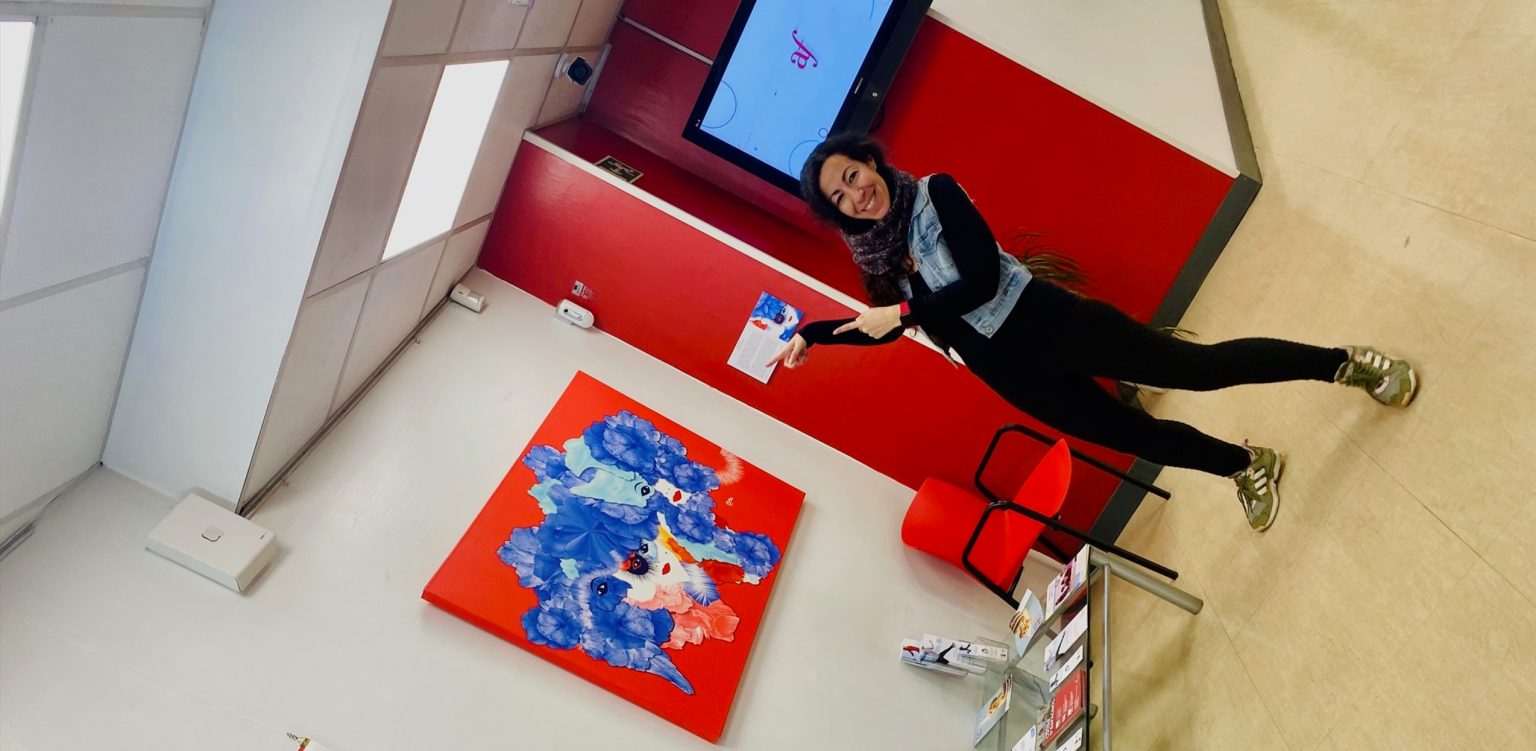
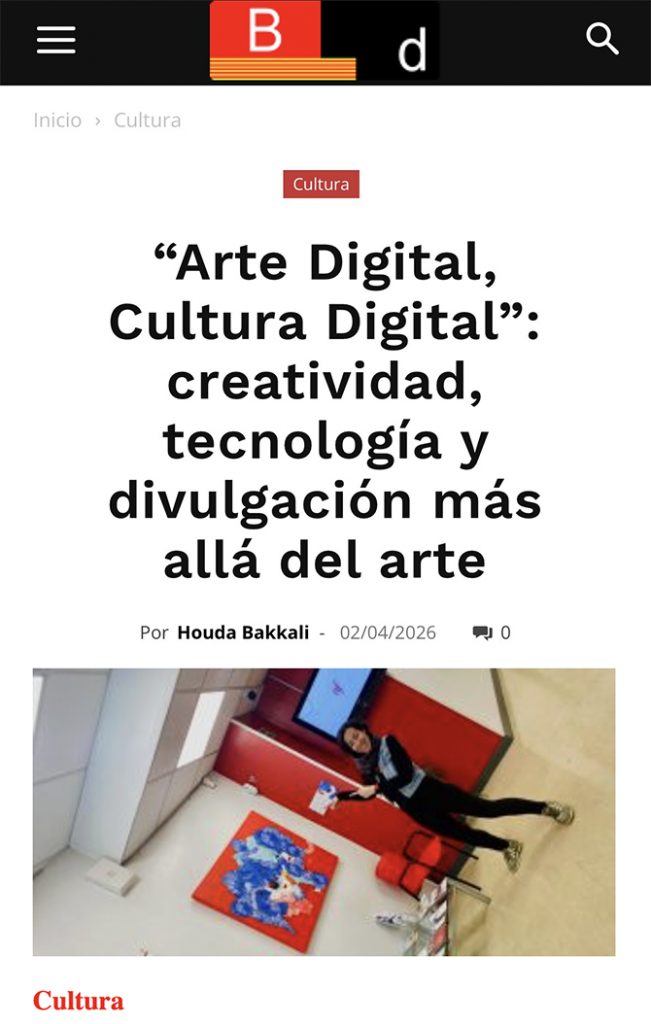
On April 2, 2024, I presented my project “Digital Art, Digital Culture” at the Alliance Française de Madrid, a project that has been, for several years, the foundation of my work in different spaces. Through the Alliance Française, I sought not only to exhibit my work, but also to explore the intersection between art, technology, and dissemination in global educational and cultural contexts. To assess how technology is not only a bridge to showcase my artistic and educational practice, but also a real bridge to break spatial, temporal, and generational barriers, capable of moving the work, its motivations, and its creative process across different contexts, interpreting its ecosystem within the international sphere, with the intention of making it dynamic, understandable, and useful for different audiences.
“Digital Art, Digital Culture” is conceived as an exhibition that merges physical art, digital versions, and audiovisual elements, but also as an environment for learning, reflection, and dialogue through educational resources integrated within the exhibition itself and, at times, also through theoretical-practical workshops. In this way, the public and the exhibition spaces that have hosted, and continue to host my work, have had the opportunity to approach some of the digital art concepts and technologies with which I usually work, especially augmented reality and immersive spaces. To see and appreciate their uses and utilities beyond the canvas and to learn about the creative tools, their advantages, challenges, and possibilities.
An exhibition format that I have had the honor of presenting at this institution for two uninterrupted years, within one of the largest cultural networks in the world, founded in 1883 in Paris by figures such as Jules Verne, Louis Pasteur, and Ferdinand de Lesseps, and whose objective is to promote Francophone cultures, education, intercultural dialogue, and diversity.
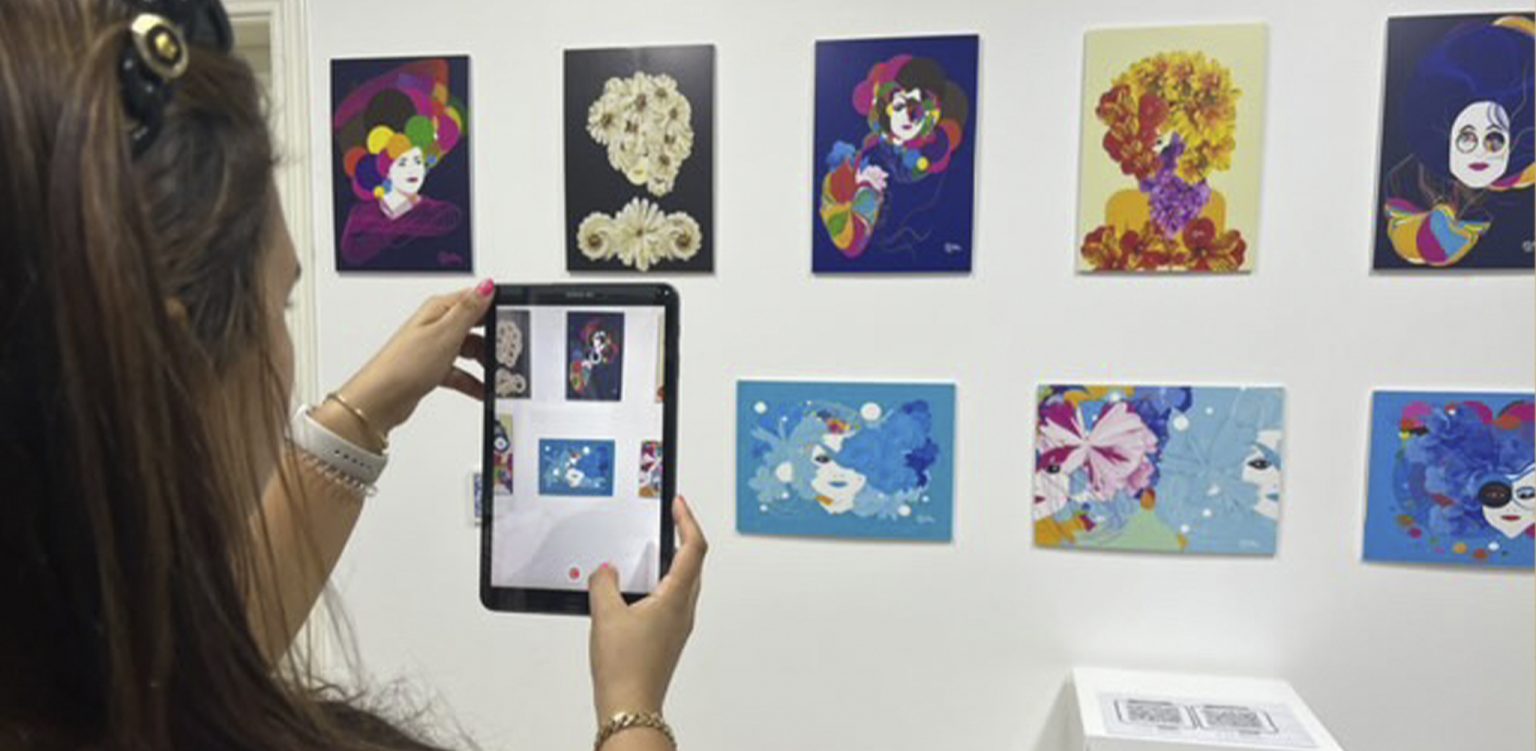
Houda Bakkali | Exhibition at the Alliance Française de Madrid, 2024
Physical art beyond the canvas
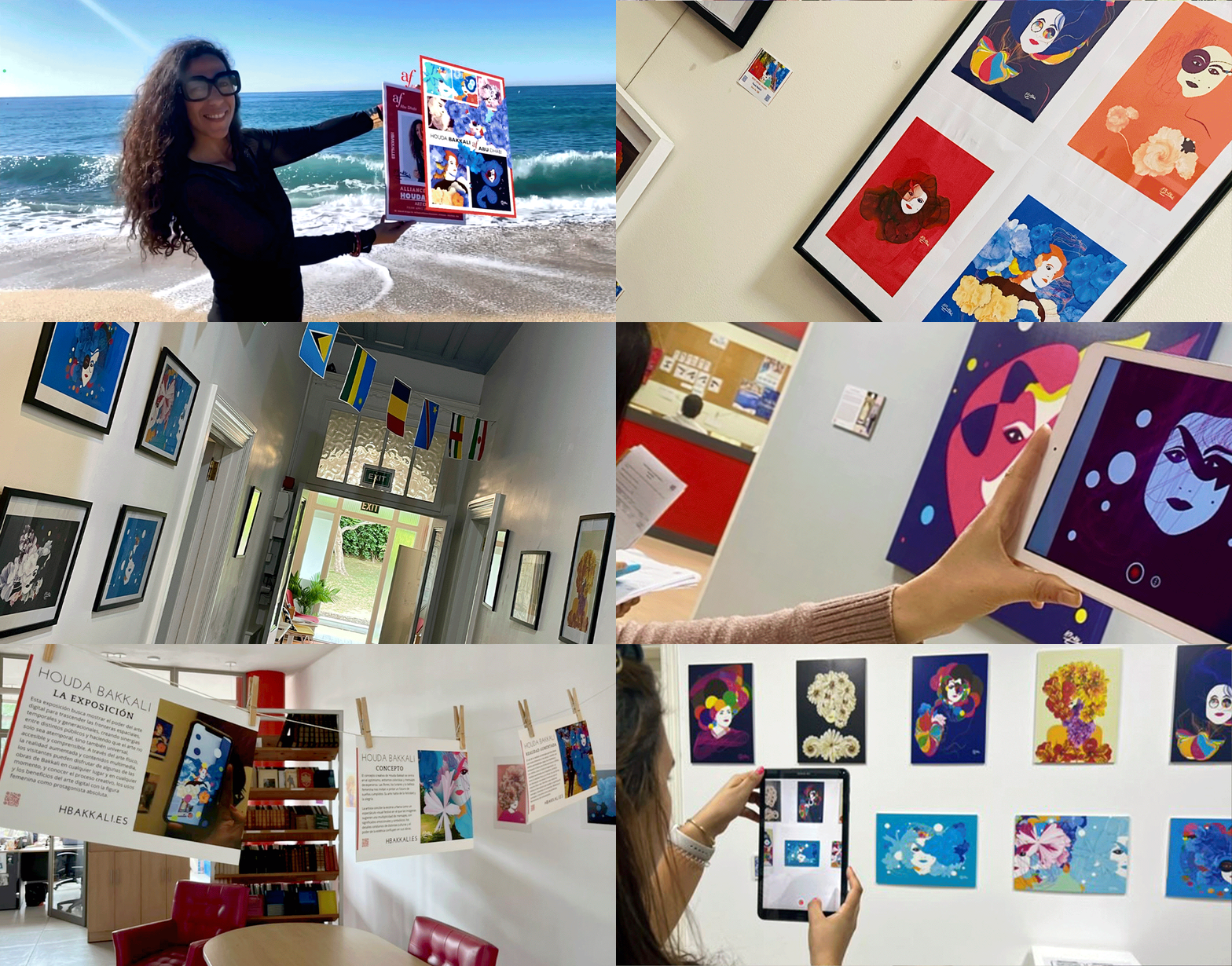
Each exhibition is based on the physical artwork. Through a mobile phone or tablet, the public can access augmented reality, as well as the interactive and audiovisual versions of each work. Each exhibition includes an audiovisual presentation, educational resources, and a virtual gallery. In this way, each piece of content seeks to complement the others and aims to facilitate public access to more details about the exhibition through different media and layers that merge information, immersion, and also entertainment.
"Digital Art, Digital Culture" Exhibition by Houda Bakkali | Alliance Française–Al Riwaq, Bahrain | Digital November, 2024
The feminine gaze
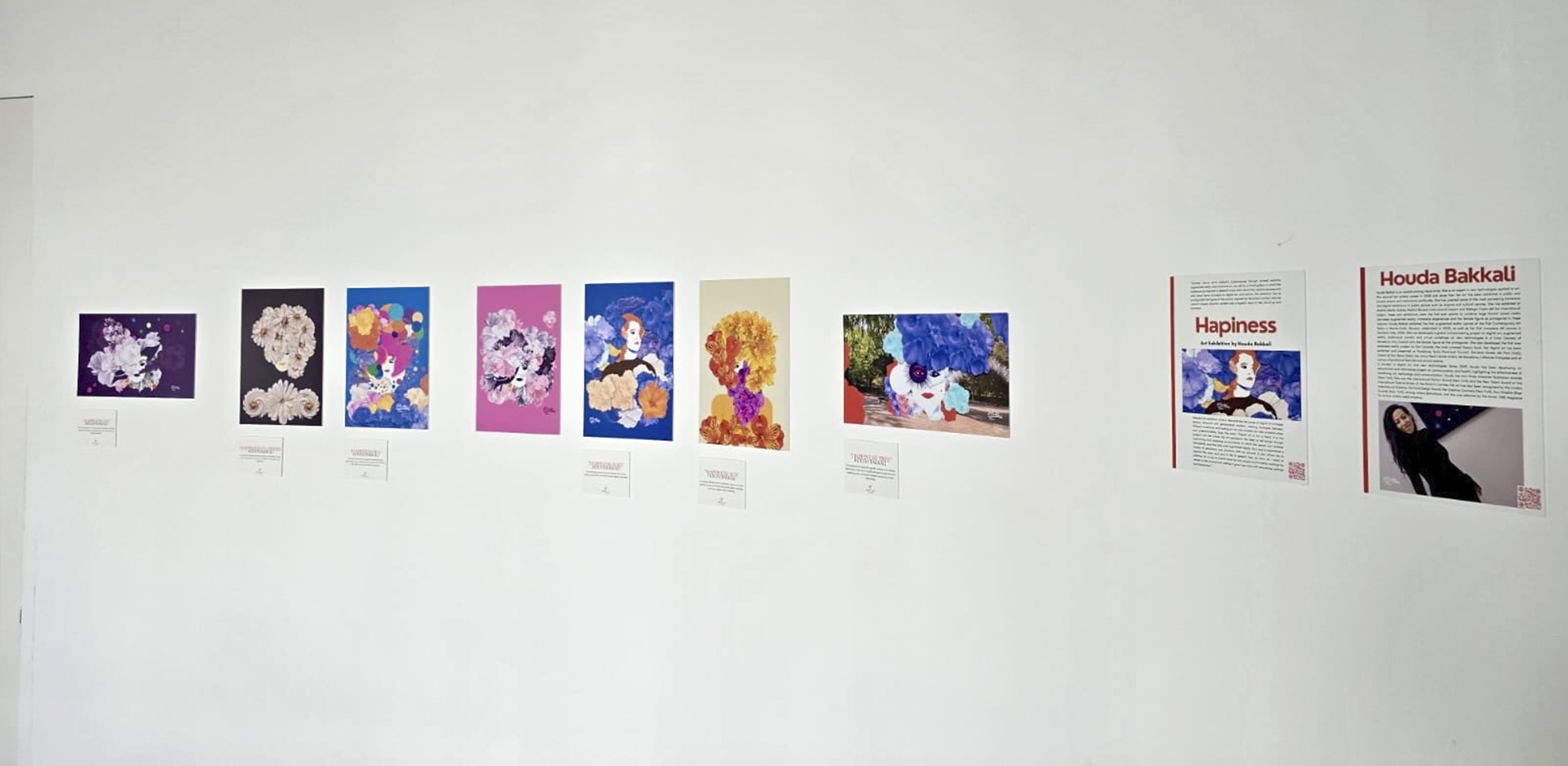
As with every work of art, the soul cannot be missing, and in my work it is represented by the female figure in tribute to my mother. The combination of the vector illustration of the woman’s figure and the collage of flowers that surrounds most of my creations seeks to offer viewers a unique perspective. In other words, always the same, although always different because it presents different content. It seeks to convey a serene, playful, optimistic, and hopeful space. A space designed to spread knowledge through tradition and innovation, through the physical and the virtual. Also, a space to highlight the value of happiness through creativity.
“Happiness” Exhibition by Houda Bakkali in Jeddah, Saudi Arabia | Alliance Française, 2024
Simultaneous, transversal, and understandable
One of the foundations of my project is to make understandable not only my work and its motivations, but also the digital tools used in its creation and dissemination. To bring digital art closer through the physical, and to expand the physical through a digital ecosystem in constant evolution.
Likewise, since that April 2, 2024, I have had the opportunity and the great honor of participating in international cultural programs organized by the Alliance Française and the Institut Français, including the Month of Francophonie 2025 and 2026 and Novembre Numérique 2024 and 2025, where my work was exhibited simultaneously in multiple cities and countries. Technology made it possible during these events to showcase my work in different spaces, formats, and for different cultures in a simultaneously way.The combination of art and new technologies once again broke spatial, temporal, and generational barriers to bring the same project and the same content to diverse audiences, inviting them not only to discover the work, but also to immerse themselves in its different dimensions and versions, interact with the information, and participate in its dynamics.
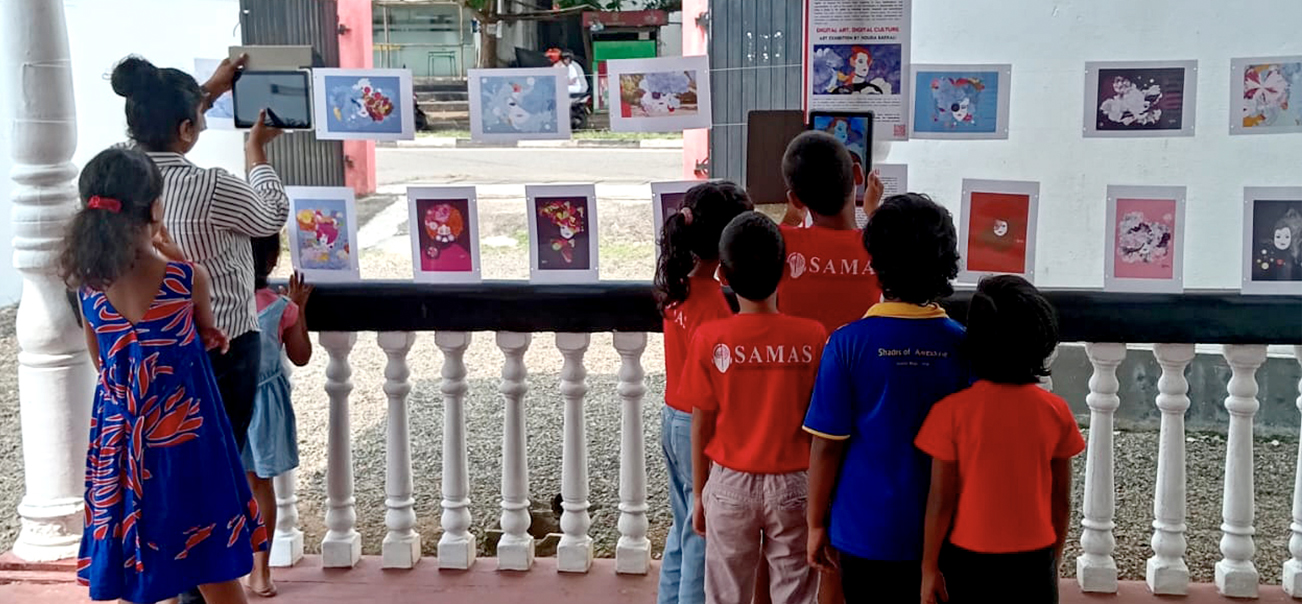
“Digital Art, Digital Culture” Exhibition by Houda Bakkali in Matara, Sri Lanka | Alliance Française | Digital November 2025
Art for medical dissemination
In this way, through my project “Digital Art, Digital Culture”, I seek to take art beyond its physical limits, while also exploring the value of the canvas beyond its aesthetic, symbolic, and emotional power. Ornamental and reflective art gains new levels of utility, becoming a container for messages about the work itself, its motivations, creative process, and applied technologies.
But I have also wanted my work to become a space for the dissemination of medical and scientific content that promotes quality information for prevention, early diagnosis, and the encouragement of healthy habits. This combination of art and technology allows me to transform my work into a space of connection where aesthetics attract attention and technology provides information, organizes it, makes it understandable, allows it to be personalized and updated in real time, and brings it closer to all audiences.
A combination with social value, beyond the aesthetic, playful, or experimental nature of the symbiosis between art and technology.
In the same spirit, each work has sought to fulfill a function, and each exhibition has aimed to create a space to educate, inform, and entertain. During these two years, I have complemented some of these exhibitions with workshops, not only to contextualize the exhibition and the creative process, but also to share ideas about the technologies used, especially augmented reality and immersive spaces.
In this way, I have structured each workshop as a meeting focused on exploring new possible dimensions of art, culture, science, education, tourism, and communication through the integration of creativity and technology, not as a trend, but as a way to promote access to all kinds of spaces and fields, with art as the interface and technology as the activator of information and facilitator of its dissemination without spatial, generational, or temporal barriers. A meeting designed to value new opportunities in cultural and educational environments, understanding art and technology as a fusion created to reach new audiences, encourage participation and learning, and also as a powerful tool to strengthen communication and marketing strategies.
Along the same lines, I have addressed the opportunities and challenges for creatives, highlighting the access to new spaces, the autonomy, and the reach that these technologies provide. Thus, in each workshop I have focused on the uses, possibilities, and challenges of this combination beyond the canvas, and on the new roles it offers both artists and institutions. In particular, I have explored augmented reality, analyzing its concept, utility, practical applications, advantages, and risks. Examining the possibilities of digital tools to bring knowledge closer in an intuitive, understandable, and accessible way.
I have developed a theoretical-practical workshop format open to all audiences and ages, implemented in 17 cities across different countries and aimed at professionals from diverse fields such as cultural management, art, education, medicine, and communication, among others.
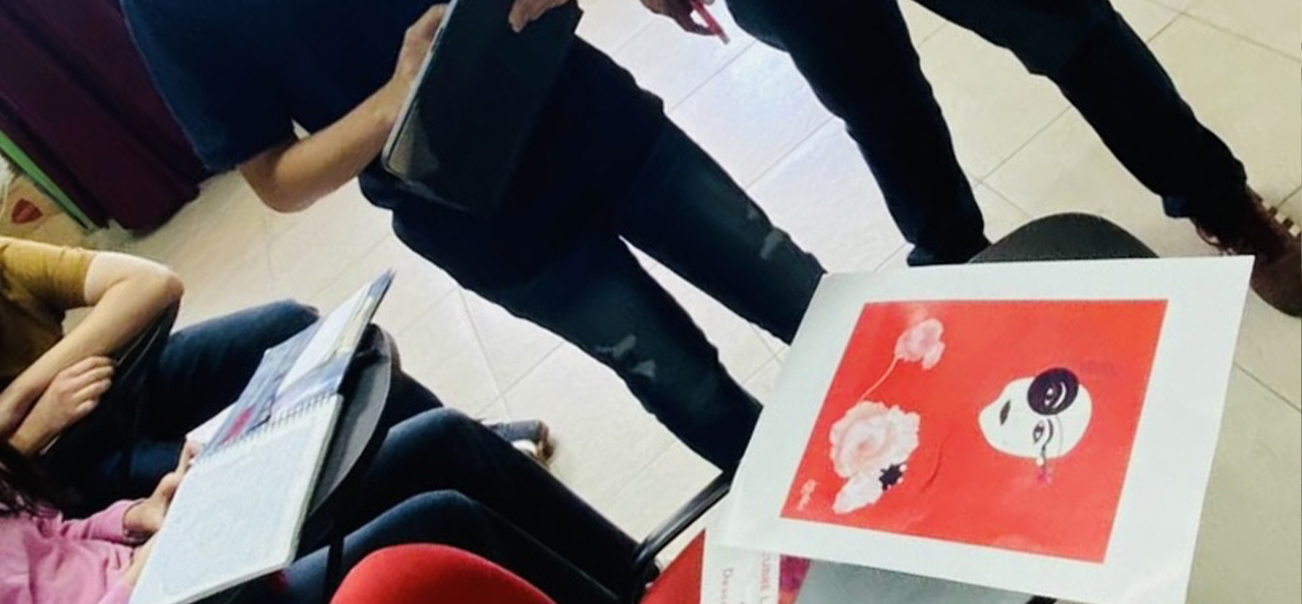
“Creativity and New Technologies Beyond Art” Workshop by Houda Bakkali | Alliance Française of Villahermosa, Mexico | Month of Francophonie, 2026
Technology is technology
In “Digital Art, Digital Culture”, I use technology as a means to an end. I seek to explain what objectives can be achieved and how to use that medium to accomplish them. I seek to explain the role of art in my work as the guiding framework, the narrative foundation, and the basis of the discourse, but also as that first visual and emotional impact that invites people to discover practically unlimited and updatable layers of content, and to participate in it not only as passive spectators, but actively from within the work itself.
In my work, technology seeks to facilitate accessibility, multidisciplinary learning, and digital literacy, analyzing its possibilities as a pedagogical tool and as a means for the democratization of knowledge with real and global impact through the canvas and beyond it.
But in my project, technology is also presented as a medium that must be understood, practiced, and activated, which compels us to carefully evaluate and consider its accessibility, usability, and effectiveness: when should it be used? For what purpose? For whom? How should it be explained? What does it contribute and what does it not? Is it controllable? And if so… how can it be controlled?
Today, technology appears to be uncontrollable and constantly changing, and it presents risks — many unpredictable, while others can be anticipated. For this reason, it cannot be understood as a trend or an experiment, but rather it must be approached with detail and responsibility. Participation in it must come from knowledge, critical thinking, and structure. Commitment to its use requires, above all, continuous learning and preparation in the face of its evolution.
In this project, I also invite reflection on how art, its value, meaning, concept, and motivations transcend technique, technology, physical space, formats, and the frames — both real and symbolic — in which it is presented. For this reason, my project has consistently and consciously displayed the same physical works in different formats, together with their continuously evolving digital versions.
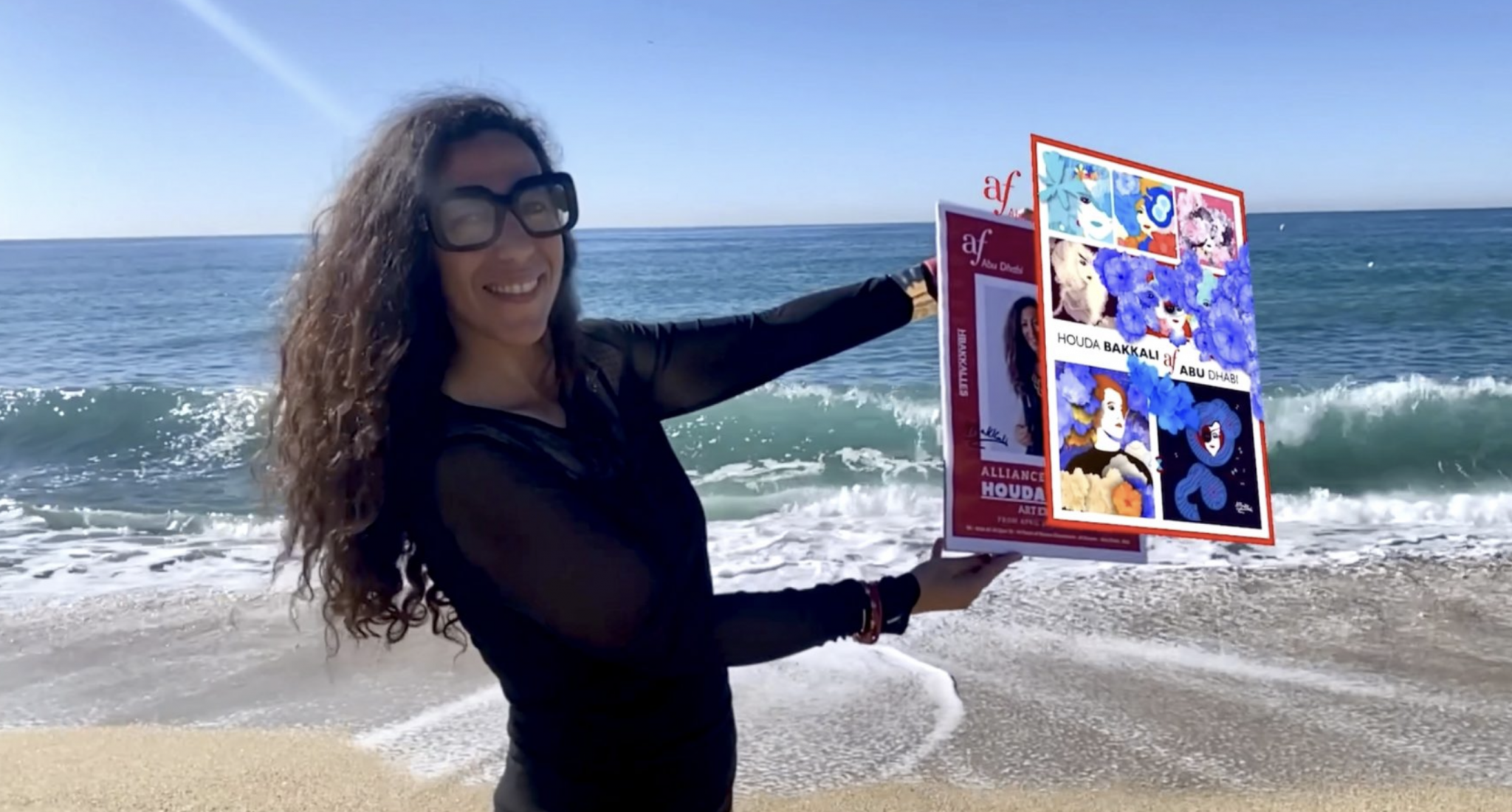
“Digital Art, Digital Culture” Exhibition by Houda Bakkali | Alliance Française, Abu Dhabi, 2024
Context and adaptation
It seems that we are living in, or moving toward, a post-digital era, as creation through digital media becomes more consolidated every day. However, it is important to approach this reality from a global rather than a local perspective.
Digital spaces, digital creation tools, and dissemination platforms do not have the same level of acceptance or adoption worldwide. The versatility of digital tools makes it possible to adapt each project to each space, while remaining aware of the sensitivity of every audience, but in this project I have not sought that adaptation. Instead, the work and all of its elements have blended organically into each space, allowing themselves to be appreciated aesthetically while being discovered through their conceptual, communicative, and informational dimensions. Allowing themselves to be carried by the rhythm of each place.
Houda Bakkali
My perspective two years later
Art that comes to life to create living projects, opening new spaces and debates, bringing digital culture closer without spatial, temporal, or generational barriers, and fostering its dissemination. Projects that change and update themselves in real time and simultaneously, while remaining within the same physical frame without altering either the work itself or its symbolic value. Projects that promote participation and reflection on the value of merging creativity and technology to educate, inform, and entertain; to bring science and culture closer and share them; to make people understand and participate; to generate new ecosystems; and to provide new and important skills to artists and institutions.
The art and digital culture that have allowed me to rediscover myself and grow, I no longer see today as a trend designed to generate headlines, but rather as a useful and increasingly accessible tool that helps us bring into focus what is unknown, forgotten, or prejudged, giving it the opportunity to have its own voice and its own headline.
Having had the opportunity to exhibit my creative practice, my work, and my vision through the Alliance Française in 43 cities across 25 countries across all five continents over these two years, alongside exceptional hosts, is more than a great honor. It is an exercise in learning and personal and cultural growth that is incomparable, and also a real and global example of how creativity and technology open new paths, new unpredictable and challenging spaces, constructive spaces capable of offering new perspectives and strengthening motivation.